Chapter 6: Driving Behaviour and Road Courtesy — theory test questions and answers
52 practice questions for the UAE driving theory test on emotional maturity, personality traits and certain types of bad behaviour, the will to learn and the need to learn, focus on driving and more, each with the correct answer and a short explanation from the handbook. Try each one before you open the answer.
Q1.Why is nobody allowed to take a driving test before the age of 18?
Insurance is not available under 18
Younger people cannot reach the pedals
People 18 and over are assumed to be mature enough to drive safely and responsibly
It is an international rule with no reason
Show answer
Answer C: People 18 and over are assumed to be mature enough to drive safely and responsibly. At 18 people are assumed to be sufficiently mature to drive safely and responsibly, although the book notes this is often far from reality.
Q2.Why are young, inexperienced drivers involved in far more accidents than older drivers?
Their cars are usually faster
They drive more kilometres
Older drivers avoid busy roads
They lack experience of the traffic environment and many are insufficiently mature
Show answer
Answer D: They lack experience of the traffic environment and many are insufficiently mature. Novice drivers have insufficient experience to understand the traffic environment and many are insufficiently mature; they also find it harder to rectify mistakes.
Q3.This picture of children fighting over a toy illustrates which stage of moral development?
The ego stage
The identity stage
The community stage
The rule stage
Show answer
Answer A: The ego stage. Infants display egoism, thinking mainly of themselves — the ego stage. Many drivers have never got past it.
Q4.What is the “rule stage” of development?
The infant thinks only of itself
The learner memorises the traffic law
The child understands that society needs rules and tries to abide by them
The adult driver shows generosity and tolerance to others
Show answer
Answer C: The child understands that society needs rules and tries to abide by them. As the child grows, egoism gives way to accepting that society needs a set of rules; the child tries to abide by them — the rule stage.
Q5.Which stage is reached by a driver who steps aside to help other road users and shows consideration?
The community stage
The rule stage
The ego stage
The prestige stage
Show answer
Answer A: The community stage. The highest level is the community stage: respect for others, tolerance and awareness that human abilities are limited — the spirit, not just the letter, of the law.
Q6.How does immaturity affect accident statistics?
It has no measurable effect
It only affects accidents at night
It reduces accidents because young drivers are cautious
It makes accidents more frequent and often more severe
Show answer
Answer D: It makes accidents more frequent and often more severe. Immaturity boosts accident statistics: an immature driver may see the car as an instrument of power that enhances his personality.
Q7.Why are role models from films and advertising a danger for young drivers?
They teach bad clutch control
They can make young people feel invulnerable so they disregard real risks
They make cars look slower than they are
They encourage careful driving
Show answer
Answer B: They can make young people feel invulnerable so they disregard real risks. Fantasy heroes always win; once young people believe themselves invulnerable they tend to disregard the very real risks in traffic.
Q8.How does a safe driver react to other people’s mistakes?
Sounds the horn to correct them
Reports them to the police
Overtakes them as soon as possible
Is not irritated by them and adapts to them
Show answer
Answer D: Is not irritated by them and adapts to them. A safe driver is not irritated by others’ mistakes; he adapts to them, remembering that other road users can make mistakes too.
Q9.How does a weak sense of identity often show itself on the road?
Always keeping below the speed limit
Driving only on familiar roads
Refusing to drive at all
Wanting to test what the car can “do”, such as taking a bend at eighty
Show answer
Answer D: Wanting to test what the car can “do”, such as taking a bend at eighty. In the experimental phase young people test how far they can go, which on the road becomes testing whether the car can take a sharp bend at eighty or be pulled out of a skid.
Q10.What does the book say about the driver who imagines he is a Formula 1 star on the highway?
He is playing a part he cannot handle, on the public highway instead of a racetrack
He is displaying good car control
He is showing emotional maturity
He should be encouraged to race professionally
Show answer
Answer A: He is playing a part he cannot handle, on the public highway instead of a racetrack. Confusing make-believe with reality is deficient reality-adaptation; he plays a role he cannot handle, and on the Corniche instead of a racetrack.
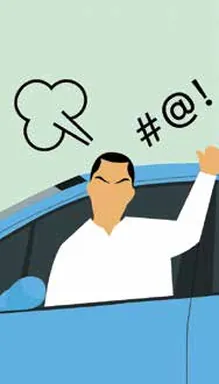
Q11.What does the book say about behaviour like this?
Aggression makes you a bad driver: it impairs judgement and causes unconsidered decisions
It improves alertness
It relieves stress and is harmless
It is acceptable if the other driver was at fault
Show answer
Answer A: Aggression makes you a bad driver: it impairs judgement and causes unconsidered decisions. Poor self-control and aggression impair your ability to assess traffic, lead to unconsidered decisions and create conflict with other drivers.
Q12.What is described as a characteristic of a good driver?
The ability to react instantly with anger
The ability to remain alert and concentrated over a long period
Driving fast without accidents
Being able to daydream safely
Show answer
Answer B: The ability to remain alert and concentrated over a long period. A good driver remains alert and concentrated over long periods; daydreaming lets attention wander from the task of driving.
Q13.In the survey described, how did young male drivers with 1–3 years’ licence rate themselves?
As below-average drivers
As beginners
As mediocre drivers
As better-than-average drivers
Show answer
Answer D: As better-than-average drivers. Young males rated themselves better than average, while young females thought themselves mediocre or below average; the accident statistics show the men overestimate.
Q14.How do experienced drivers scan the road compared with novices?
Less often, because they trust their reflexes
They treat all bends the same
Only in the mirrors
More extensively and systematically, scanning right- and left-hand bends differently
Show answer
Answer D: More extensively and systematically, scanning right- and left-hand bends differently. Experienced drivers scan more extensively and systematically and recognise more potential hazards; novices treat all bends alike and see traffic as static.
Q15.Where do inexperienced drivers tend to look, suggesting uncertainty about their road position?
Off to the right of their vehicle
At the speedometer
Constantly in the rear-view mirror
Far ahead on the horizon
Show answer
Answer A: Off to the right of their vehicle. Inexperienced drivers tend to look off to the right of the vehicle, take longer to react, drive faster and less smoothly.
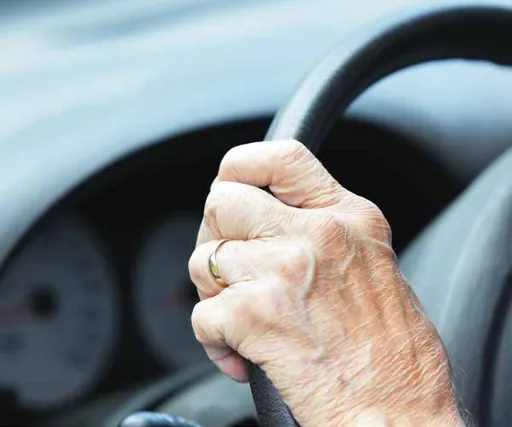
Q16.What does the book say about elderly drivers like the one pictured?
They overestimate their abilities like young drivers
They cause most single-vehicle accidents
They should never drive in daylight
They are mostly courteous and considerate and seldom involved in single-vehicle accidents
Show answer
Answer D: They are mostly courteous and considerate and seldom involved in single-vehicle accidents. Elderly drivers are usually courteous, critical of their own performance, and seldom involved in single-vehicle accidents; they should adapt to their physical abilities and avoid night and heavy traffic if possible.
Q17.What driving conditions should elderly drivers avoid if possible?
Driving with passengers
Driving at night and in heavy traffic
Driving in the right-hand lane
Driving on motorways
Show answer
Answer B: Driving at night and in heavy traffic. Elderly drivers must adapt driving to their physical abilities and, if possible, avoid driving at night and in heavy traffic.
6.2 Personality traits and certain types of bad behaviour
Q18.How does the book define the impulsive personality?
One that drives slowly and cautiously
One that acts first and thinks later — dangerous in traffic
One that follows rules to the letter
One that hesitates too long at junctions
Show answer
Answer B: One that acts first and thinks later — dangerous in traffic. Impulsiveness — acting first and thinking later — is typical of children and merely dangerous in traffic; it may cause loss of control.
Q19.Why is constantly making excuses and blaming others a barrier to becoming a good driver?
It leads to higher insurance
They never admit mistakes, so they never change their behaviour or learn from experience
It annoys the police
It wastes time at accident scenes
Show answer
Answer B: They never admit mistakes, so they never change their behaviour or learn from experience. Drivers who blame others feel no need to admit they were wrong, so they never modify their behaviour and cannot learn from experience.
Q20.A driver overtakes although he knows he cannot see far enough, pushing the danger from his mind. What is this called?
Repression
Learning by imitation
Reaction formation
Probability conditioning
Show answer
Answer A: Repression. Repression is pushing unpleasant thoughts aside; it reduces awareness of danger and increases risk-taking, so the accident rate rises.
Q21.A shy, insecure driver behaves with aggressive rudeness to appear bold. What is this mechanism?
Repression
Reaction formation
Group pressure
Overlearning
Show answer
Answer B: Reaction formation. Reaction formation is doing the opposite of how you feel: insecurity shows as aggressive rudeness; it has caused many accidents.
Q22.What motive lies behind “prestige” behaviour on the road?
Fear of being late
Respect for other drivers
A desire to save fuel
A feeling of superiority and the notion that other road users should make way
Show answer
Answer D: A feeling of superiority and the notion that other road users should make way. Prestige-driven self-assertion is based on a feeling of superiority over other drivers and the notion that others should make way.
Q23.Another driver provokes you and you know you are in the right. What does the book advise?
Stop and confront the driver
Assert your right firmly so the other driver learns
Do not take up the challenge; “an eye for an eye” only increases the chance of an accident
Match the other driver’s speed to make your point
Show answer
Answer C: Do not take up the challenge; “an eye for an eye” only increases the chance of an accident. No matter who is right, taking up the challenge merely increases your likelihood of causing an accident.
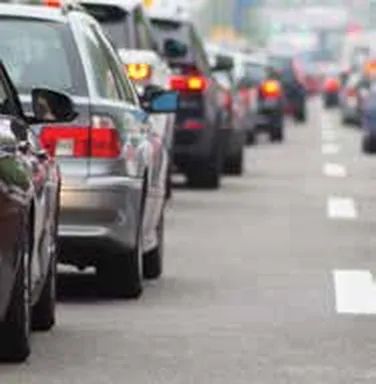
Q24.You are in a queue like this and a driver pushes through gaps to reach the front. What does the book say?
It breaches the Traffic Law, causes accidents and shows an inconsiderate personality
It shows good anticipation
It is allowed for taxis
It is acceptable if done slowly
Show answer
Answer A: It breaches the Traffic Law, causes accidents and shows an inconsiderate personality. Jumping the queue breaches the Traffic Law, is a potential cause of accidents and a bad example; do not do it — it saves only seconds.
Q25.You never meet cars at a local junction, so you stop slowing down there. What is this form of learning called?
Reaction formation
In-depth learning
Probability conditioning
Overlearning
Show answer
Answer C: Probability conditioning. Probability conditioning adapts habits to how often you expect an event; it invades the subconscious and breeds dangerous habits — when a car does come you have no chance.
Q26.After passing the test, what serious risk does learning by imitation pose?
Forgetting what the instructor taught in favour of the bad habits seen around you
Refusing to overtake
Driving too slowly
Copying the instructor too closely
Show answer
Answer A: Forgetting what the instructor taught in favour of the bad habits seen around you. Once lessons stop, there is a strong risk of ignoring what you learned in favour of the bad driving styles seen on the road; nobody can force you to adopt bad habits.
Q27.What does the book call the belief that knowing the rules and being able to manoeuvre a car is enough?
In-depth learning
Superficial learning
Overlearning
Group learning
Show answer
Answer B: Superficial learning. Believing that rules plus car handling make a driver reflects superficial learning; if you want to be a good driver it is not enough.
Q28.What does in-depth learning require?
Memorising the traffic rules by heart
Directly experiencing, discussing and analysing many traffic situations with your teacher
Driving alone as much as possible
Passing the theory test with full marks
Show answer
Answer B: Directly experiencing, discussing and analysing many traffic situations with your teacher. In-depth learning comes from experiencing, discussing and analysing traffic situations with your teacher; only then is knowledge permanently retained.
Q29.What is “overlearning”?
Learning more rules than necessary
Studying too much theory before the test
Taking more lessons than required by law
Practising new skills over and over, beyond mastery, until they become automatic
Show answer
Answer D: Practising new skills over and over, beyond mastery, until they become automatic. Overlearning means practising skills beyond the point of mastery until driving becomes second nature.
Q30.How should you regard yourself after passing your test?
As safer than average, having had professional training
As a beginner who still needs a great deal of practical experience
As ready for motorway racing
As a fully qualified expert
Show answer
Answer B: As a beginner who still needs a great deal of practical experience. Even after excellent training and passing the test, regard yourself as a beginner who needs much practical experience before being reasonably safe.
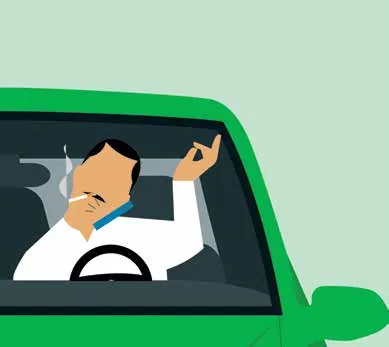
Q31.What is wrong with the driver in this picture?
Only the cigarette is a problem
Nothing, as long as the car is stopped
Smoking and phoning distract; keep hands on the wheel, eyes on the road, mind on traffic
Only the phone is a problem
Show answer
Answer C: Smoking and phoning distract; keep hands on the wheel, eyes on the road, mind on traffic. Emotional problems, phoning, smoking and changing CDs all distract; doing two things at once is very risky, especially for inexperienced drivers.
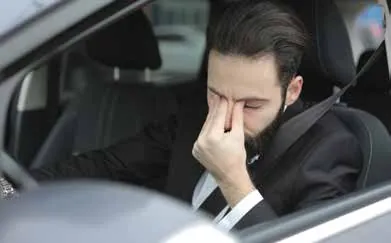
Q32.The driver pictured is stressed. When does stress arise?
Only after driving for more than 4 hours
When the car is faster than the driver’s skill
When the demands of the situation exceed the ability of the driver
Only in heavy rain
Show answer
Answer C: When the demands of the situation exceed the ability of the driver. Stress arises when demands exceed the driver’s ability; it converts mental energy into anxiety and irrational reactions.
Q33.Is all stress negative for a driver?
No, a certain degree of mental stress can markedly improve performance
Yes, except for professional drivers
No, more stress always means better focus
Yes, any stress harms driving
Show answer
Answer A: No, a certain degree of mental stress can markedly improve performance. Excessive stress should be avoided, but a certain degree of mental stress can markedly improve performance; tolerance builds with experience.
Q34.Your friends in the car urge you to speed and overtake dangerously. What is this called?
Reaction formation
Prestige
Repression
Group pressure
Show answer
Answer D: Group pressure. Group pressure pushes a person to modify behaviour to fit the wishes of others; the driver values passengers’ opinions over his own judgement.
Q35.Can group pressure ever be positive?
Only for passengers, not drivers
Yes, a group with sound values may persuade a driver going astray to mend his ways
No, it is always harmful
Only in professional convoys
Show answer
Answer B: Yes, a group with sound values may persuade a driver going astray to mend his ways. Group pressure is not always negative; a group with sound values, expressed firmly and respectfully, can steer a driver back.
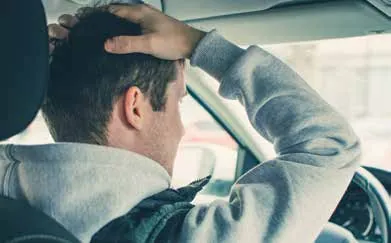
Q36.The driver in the picture is fighting fatigue. What is the most effective way to counteract sleepiness?
Turn up the radio
Open the window for fresh air
Drink a cold drink
Take a short nap
Show answer
Answer D: Take a short nap. Fresh air or exercise help only briefly; the most effective way to counteract sleepiness is a short nap. Plan regular rest stops, especially at night.
Q37.What is usually the first hint that you are getting tired at the wheel?
Blurred vision
Falling asleep briefly
Yawning
A feeling of disconnection and slowness of thought
Show answer
Answer D: A feeling of disconnection and slowness of thought. Fatigue creeps up in stages: first disconnection and slow thought, then slower reactions, then yawning, then an irresistible urge to sleep.
Q38.What is possibly the most common reason for tiredness when driving?
The combination of physical exertion and monotony
Bright sunlight
Lack of food
Loud music
Show answer
Answer A: The combination of physical exertion and monotony. Tiredness usually comes from physical exertion plus monotony; a busy noisy road also tires eyes and ears. Do not drive too long without a break.
Q39.You are taking medicines like these. What should you do before driving?
Take a double dose to feel better
Take them only after driving
Check whether they affect driving; even cough and fever medicines can cause drowsiness
Nothing; only prescription drugs matter
Show answer
Answer C: Check whether they affect driving; even cough and fever medicines can cause drowsiness. Read the packet or ask your doctor or pharmacist; even cough and fever medicines can make you drowsy, and even a cold can make driving unsafe.
Q40.After heavy drinking (about 25 cl of spirit), how long until the body is entirely alcohol-free?
2–3 hours
12–15 hours
6 hours
24–48 hours
Show answer
Answer B: 12–15 hours. Only about 2 cl of 40% spirit is eliminated per hour, so after 25 cl it takes 12–15 hours; you may still be unfit the next morning.
Q41.What happens to a driver found to have any blood-alcohol content under UAE law?
Must retake the theory test
Receives a warning for a first offence
Loses their licence and is fined and/or sent to prison
Pays a fine only
Show answer
Answer C: Loses their licence and is fined and/or sent to prison. Any driver found with a blood-alcohol content loses their licence and is fined and/or imprisoned; if you drink, do not drive.
Q42.Which part of your vision deteriorates gradually with alcohol without you noticing?
Peripheral vision
Night vision only
Central vision
Colour vision
Show answer
Answer A: Peripheral vision. Drivers claim a few drinks do not affect eyesight because central vision seems fine, but peripheral vision gradually deteriorates unnoticed.
Q43.What does the book say about driving under the influence of illegal drugs?
It affects only reaction time
It is legal in small quantities
It is an offence; the effects are unpredictable and can be even worse than alcohol
It is safer than alcohol
Show answer
Answer C: It is an offence; the effects are unpredictable and can be even worse than alcohol. Driving under the influence of illegal drugs is an offence; effects are unpredictable and may be more serious than alcohol, causing fatal accidents.
Q44.Under Federal Law, when may you use a mobile phone while driving?
Only when stopped at traffic lights
Never, under any circumstances
Only with a hands-free set (still not advisable)
Only for calls shorter than one minute
Show answer
Answer C: Only with a hands-free set (still not advisable). Federal Law forbids using a mobile while driving unless hands-free; hands-free is less risky but still not advisable, and dialling is very dangerous.
Q45.Your mobile rings while you are driving. What should you do?
Answer briefly on loudspeaker
Read the caller ID and decide
Don’t answer; wait until you can stop safely and then call back
Answer only if it is an emergency contact
Show answer
Answer C: Don’t answer; wait until you can stop safely and then call back. Do not answer a call while driving; stop safely first and call back. Never read, and certainly never type, a text while driving.
Q46.Why is talking on a mobile phone not the same as talking to a passenger?
A passenger sees the traffic and goes quiet; a caller is confused when you stop talking
A passenger talks more loudly
Phone calls are shorter
Passengers can hold the wheel
Show answer
Answer A: A passenger sees the traffic and goes quiet; a caller is confused when you stop talking. Passengers adjust to the traffic situation and keep quiet when you deal with a problem; a phone caller cannot see it and gets confused.
Q47.How should small children travel in the car?
In the back seat without a belt on short trips
Standing between the front seats
Seated and well secured in special child seats, never moving around the vehicle
On an adult’s lap in the front
Show answer
Answer C: Seated and well secured in special child seats, never moving around the vehicle. Never let children move around the vehicle; they should be seated and secured in the special seats made for them; if possible have someone responsible for them.
Q48.You need to make a complicated adjustment to the GPS or music player. What should you do?
Stop and make the adjustment safely
Do it slowly while driving in the right lane
Ask a passenger to hold the wheel
Do it at the next red light only
Show answer
Answer A: Stop and make the adjustment safely. Never set up or make complicated adjustments to equipment while driving; stop and do it safely.
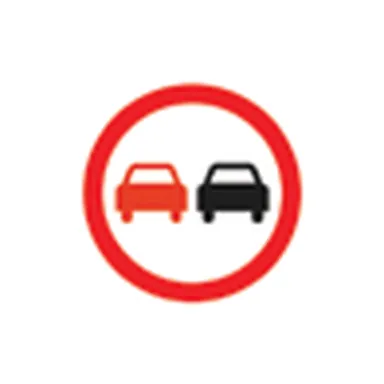
Q49.Disregarding this sign is listed as a penalised traffic offence. What does the sign show?
No motor vehicles
No overtaking
No parking alongside another vehicle
Two-way traffic
Show answer
Answer B: No overtaking. Disregarding a No Overtaking sign is one of the offences penalised by sanctions, alongside speeding, red lights, defective brakes and not wearing a seat belt.
Q50.Stopping where this sign is posted is a penalised offence. What does the sign mean?
End of restrictions
No stopping
No entry
No parking (brief stops allowed)
Show answer
Answer B: No stopping. Stopping in a No Stopping area is a penalised offence, as is parking at a bus stop or in a space reserved for disabled persons.
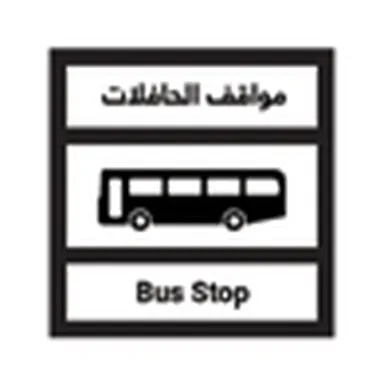
Q51.Parking at the place marked by this sign is a penalised offence. What does the sign mark?
A loading zone
A taxi zone
A parking bay for buses
A bus stop
Show answer
Answer D: A bus stop. Parking on a marked bus stop or in a space reserved for disabled persons is a penalised offence.
Q52.Which of these is listed as a penalised traffic offence?
Using dipped headlights by day
Stopping at a green light
Having defective foot brakes
Driving with the radio on
Show answer
Answer C: Having defective foot brakes. Penalised offences include speeding, red lights, defective foot brakes, defective exhaust, no seat belt, crossing a prohibitory line, ignoring No Overtaking, and illegal stopping or parking.
smartphone Android app
Practise anywhere, even offline
The free Android app has the same questions, a timed mock exam, road-sign flashcards and a daily practice streak. Sign in with Google to keep it in step with this website.