Chapter 5: Critical Situations — theory test questions and answers
49 practice questions for the UAE driving theory test on what is the main cause of traffic accidents?, different types of critical situation and accident, the impact of intersection design, camels and other animals on the road and more, each with the correct answer and a short explanation from the handbook. Try each one before you open the answer.
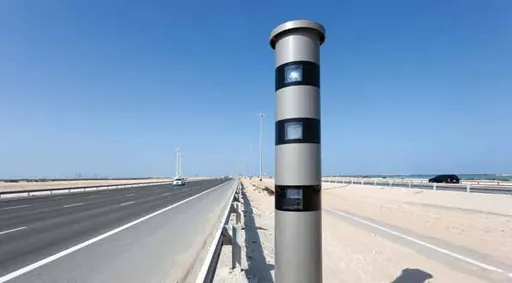
Q1.Devices like this target what is considered the principal cause of over half of UAE road accidents. What is it?
Using mobile phones
Speeding
Tailgating
Not wearing seat belts
Show answer
Answer B: Speeding. Speeding is considered the principal cause of more than half of all road accidents in the UAE, though the root cause is a lack of road courtesy.
Q2.What does the book identify as the root cause behind speeding-related accidents?
Bad weather
Vehicle defects
Poor road design
A lack of road courtesy
Show answer
Answer D: A lack of road courtesy. A closer look shows the root cause is a lack of road courtesy: some drivers forget the road is not their private property.
Q3.How many of every 10 people killed in Abu Dhabi traffic accidents are men?
Five
Seven
Ten
Nine
Show answer
Answer D: Nine. Nine out of 10 persons killed in Abu Dhabi traffic accidents are men, and over 70% of victims are young male Emiratis.
5.2 Different types of critical situation and accident
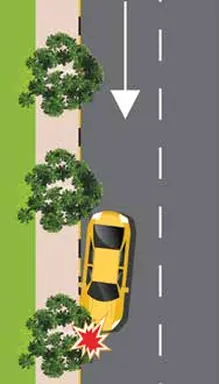
Q4.The picture shows a run-off-road crash. What does the book say about this type of accident?
They are rare and usually minor
Single-vehicle accidents are the most common type and cause the most serious injuries
They only happen at night
They are mostly caused by other drivers
Show answer
Answer B: Single-vehicle accidents are the most common type and cause the most serious injuries. Single-vehicle accidents (run-off-road, rollovers, hitting debris or animals) are the most common type and account for the most serious injuries.
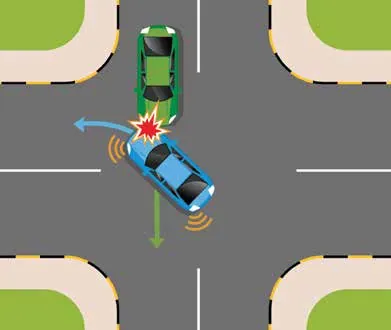
Q5.Which of these is a common cause of a crossroads collision like the one pictured?
Using dipped headlights
Believing the intersection was clear because the traffic light was green
Stopping at a green light
Driving too slowly through the junction
Show answer
Answer B: Believing the intersection was clear because the traffic light was green. Crossroad accidents happen when drivers ignore rules, miss signs, drive too fast, assume a green light means clear, or misjudge distance to the junction.
Q6.Which of these is a common cause of a collision while turning?
Taking an oncoming motorcycle for a moped
Turning from the correct lane
Signalling too early
Waiting for oncoming traffic to pass
Show answer
Answer A: Taking an oncoming motorcycle for a moped. Turning collisions are caused by misjudging an oncoming vehicle’s distance, mistaking a motorcycle for a moped, or not watching following traffic.
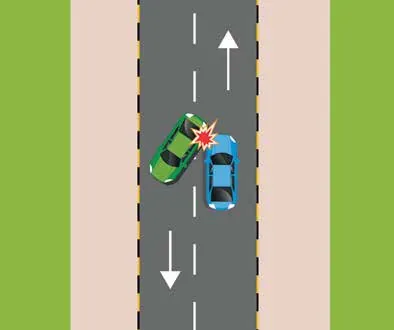
Q7.The picture shows a head-on collision. What does the book say about these accidents?
They are the least common accident
The worst kind: most deaths and injuries, often caused by misjudged overtaking
They only happen on motorways
They are usually minor because both drivers brake
Show answer
Answer B: The worst kind: most deaths and injuries, often caused by misjudged overtaking. Accidents between vehicles travelling in opposite directions have the most serious consequences and are very often caused by misjudged overtaking.
Q8.Which of these is listed as a cause of head-on collisions?
Driving too close to the right edge
Dipping headlights too early
Using the horn on a bend
Cutting across a left-hand bend
Show answer
Answer D: Cutting across a left-hand bend. Head-on collisions are caused by braking so hard the wheels lock, cutting across a left-hand bend, and driving too fast.
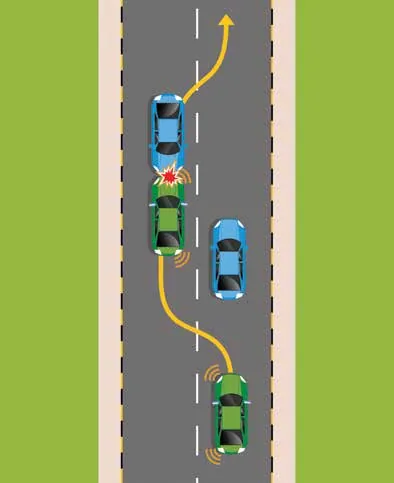
Q9.The overtaking driver in the picture has crashed. Which mistake is a typical cause?
Returning to the right lane too late
Overestimating own acceleration and forgetting the other driver may also accelerate
Indicating before pulling out
Overtaking on a straight road
Show answer
Answer B: Overestimating own acceleration and forgetting the other driver may also accelerate. Overtaking accidents come from a restricted view, misjudging oncoming speed and distance, overestimating acceleration, or meeting a vehicle when passing a long lorry.
Q10.When is it permissible to refrain from overtaking?
Only on motorways
Only if you have signalled first
Only if the vehicle ahead is slower than 40 km/h
Always
Show answer
Answer D: Always. Remember: it is always permissible to refrain from overtaking.
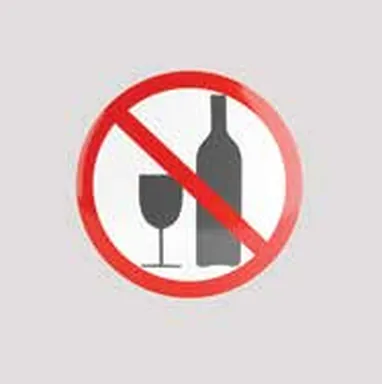
Q11.What is the book’s simple rule illustrated by this symbol?
Never drink and drive
Alcohol is allowed below the legal limit
Do not drink alcohol within two hours of driving
Only the driver must not drink
Show answer
Answer A: Never drink and drive. The simple rule is never drink and drive; any intoxicant greatly increases the risk of collision and serious injury.
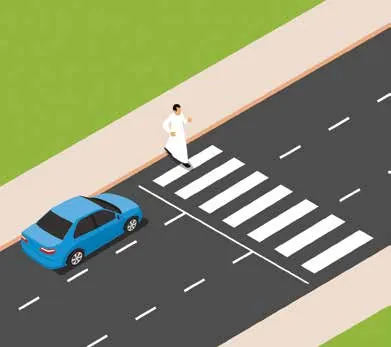
Q12.In this scene, which driver error commonly leads to a pedestrian crossing accident?
Slowing down to scan the road
Giving way to the pedestrian
Stopping before the crossing
Not noticing or ignoring the pedestrian on the other side of the crossing
Show answer
Answer D: Not noticing or ignoring the pedestrian on the other side of the crossing. Common causes: not noticing the pedestrian on the far side, obstructed view by the doorpost, driving too fast, not scanning, or overtaking a vehicle stopped at a crossing.
Q13.What can obstruct a driver’s view of a pedestrian at a crossing?
The pedestrian’s clothing
The road markings
The doorpost or blind spot of the car
The rear-view mirror
Show answer
Answer C: The doorpost or blind spot of the car. The car’s doorpost or blind spot can hide a pedestrian at the side of the crossing.
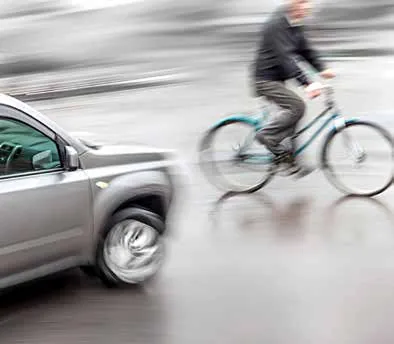
Q14.What are the common causes of accidents involving cyclists like the one pictured?
Ignoring the cyclist and misjudging the cyclist’s speed and intention
Drivers giving cyclists too much room
Cyclists wearing bright clothing
Cyclists riding too slowly
Show answer
Answer A: Ignoring the cyclist and misjudging the cyclist’s speed and intention. Cyclist accidents are caused by ignoring the cyclist and misjudging their speed and intention.
Q15.Which of these is a probable cause of accidents in the dark?
Using dipped headlights
Driving slower than in daylight
Driving closer to the centre line
Not considering the limited ability to see in the dark
Show answer
Answer D: Not considering the limited ability to see in the dark. Night accidents come from misjudging speed and intention, driving too fast, and not allowing for our limited ability to see in the dark.
Q16.The picture shows a rear-end collision. Where and among whom are these most common?
On motorways, among lorry drivers
Inside city limits, especially among taxi drivers
At roundabouts, among learner drivers
On dirt roads, among off-roaders
Show answer
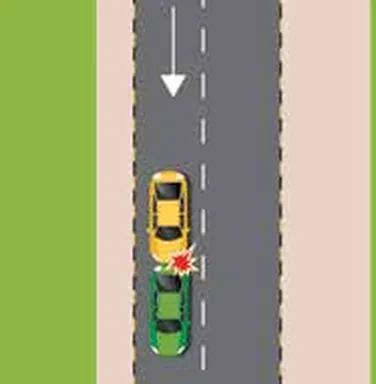
Answer B: Inside city limits, especially among taxi drivers. Rear-end collisions come from driving too close and sudden stops (e.g. taxis); they are most common inside city limits and among taxi drivers.
Q17.Why are motorcycles like this one often involved in accidents with cars?
They are smaller, approach at unexpected speeds and create their own lane between vehicles
Their headlights are too bright
They are always faster than cars
They must use the hard shoulder
Show answer
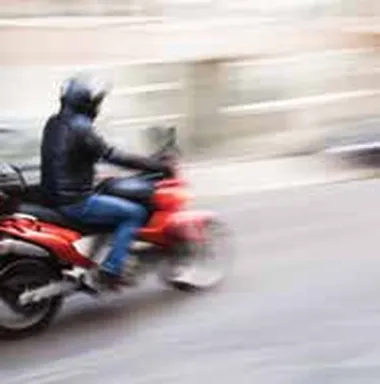
Answer A: They are smaller, approach at unexpected speeds and create their own lane between vehicles. Drivers fail to see motorcycles because they are small and approach at unexpected speeds, and neglect to watch for them filtering between lines of vehicles.
Q18.Which type of junction does the book call the safest when properly designed?
A staggered junction
A roundabout
An ordinary junction without signs
A junction with traffic lights
Show answer
Answer B: A roundabout. A properly designed roundabout is the safest junction: a sharp entrance reduces speed and accidents there are few and rarely severe.
Q19.The picture shows a sideswipe at a roundabout. What does the book say about such accidents?
They are usually fatal
They only occur at night
They are the most severe junction accidents
They tend to cause very few injuries
Show answer
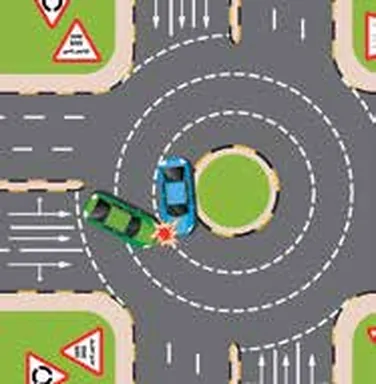
Answer D: They tend to cause very few injuries. Fewer accidents occur at roundabouts and sideswipe accidents there tend to cause very few injuries.
Q20.Why are accidents at traffic-light junctions often very severe even though they are fewer?
Because drivers never stop there
Because there are more pedestrians
Because the lights are hard to see
Because of the high speeds involved
Show answer
Answer D: Because of the high speeds involved. Traffic lights reduce accident numbers, but crashes that do happen there are often severe because of the high speeds involved.
Q21.The traffic lights at a junction have failed. How should you behave?
Wait for a police officer before proceeding
With extreme care and courtesy, since drivers are confused about priority
Proceed at normal speed; the Left Hand Rule always applies
Treat it as a roundabout
Show answer
Answer B: With extreme care and courtesy, since drivers are confused about priority. When lights are not working drivers are confused about who has priority; extreme care and courtesy must be exercised.
Q22.Why can a pedestrian crossing itself be unsafe?
Pedestrians feel safe on it and become less careful when crossing
Drivers cannot see the stripes
Cars must speed up before them
Crossings are always placed on bends
Show answer
Answer A: Pedestrians feel safe on it and become less careful when crossing. Pedestrians get a feeling of safety on a crossing and are less careful; drivers must slow down before entering the crossing.
Q23.What effect does reducing speed have on accidents?
It does not eliminate accidents but greatly reduces their severity
It eliminates accidents completely
It has no effect on severity
It increases the number of rear-end collisions
Show answer
Answer A: It does not eliminate accidents but greatly reduces their severity. Speed is always the main factor for injuries and fatalities; reducing speed greatly reduces the severity of an accident.
Q24.What does this warning sign mean?
Police checkpoint ahead
Level crossing ahead
Roundabout ahead
Traffic lights ahead
Show answer
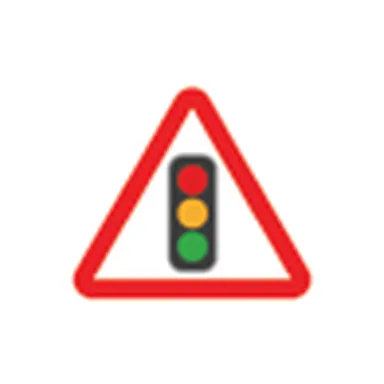
Answer D: Traffic lights ahead. Traffic lights ahead: be ready to stop; remember that even a green light does not guarantee the junction is clear.
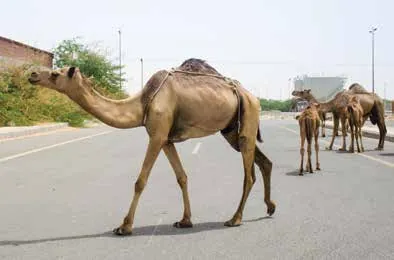
Q25.You come across camels on the road as pictured. What should you do?
Overtake them quickly on the left
Stop and get out to shoo them away
Sound the horn to move them off the road
Slow right down to a crawl, be patient, and warn others with your hazard lights
Show answer
Answer D: Slow right down to a crawl, be patient, and warn others with your hazard lights. Slow to a crawling speed and negotiate the hazard patiently; warning other drivers with hazard lights is one of the few acceptable uses of hazard lights while moving.
Q26.At what times of day are animals least visible and most likely to stray onto the road?
Midnight
Dawn and dusk
Midday
Mid-afternoon
Show answer
Answer B: Dawn and dusk. Dawn and dusk are when animals are least visible and most likely to stray; camels may find gaps even in fenced roads.
Q27.A camel has wandered onto the road ahead. How do you avoid a collision?
Overtake it on the right
Stay behind it
Flash your lights until it moves
Drive around it on the hard shoulder
Show answer
Answer B: Stay behind it. To avoid a collision, stay behind a camel that has wandered onto the road; keep a broad field of vision and a steady slow pace.
Q28.A small animal runs onto the road. Why can it still cause a severe accident?
Small animals damage the tyres
They are protected by law
Drivers overreact and slam on the brakes in panic
They always travel in herds
Show answer
Answer C: Drivers overreact and slam on the brakes in panic. Drivers often overreact to small animals and brake in panic; to avoid injuring people it may occasionally be necessary to run over a small animal.
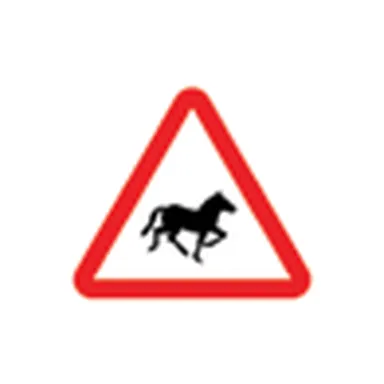
Q29.What does this warning sign mean?
Wild animals ahead
Animal grid ahead
Accompanied horses or ponies may be crossing the road
Horse riding prohibited
Show answer
Answer C: Accompanied horses or ponies may be crossing the road. This warns of accompanied horses or ponies crossing; slow down and pass wide and slow.
Q30.Which of these helps you avoid critical situations on a long journey?
Weave between lanes to keep alert
Read the map while driving slowly
Take a break every now and then to get out and stretch your legs
Eat while driving to save time
Show answer
Answer C: Take a break every now and then to get out and stretch your legs. Take breaks on long journeys, keep to your lane, do not look at maps or eat while driving — stop at a lay-by instead.
Q31.Which brake lights should you watch to anticipate trouble ahead?
Only those of vehicles in the next lane
Only those of the vehicle directly in front
Those of the vehicle directly in front and of vehicles further ahead
Brake lights are not a reliable warning
Show answer
Answer C: Those of the vehicle directly in front and of vehicles further ahead. Look out for braking lights on the vehicle in front and on vehicles further ahead so you can react early.
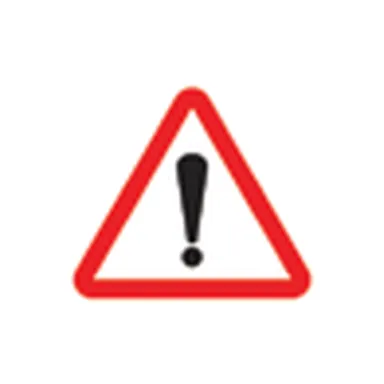
Q32.What does this warning sign mean?
Hazard ahead (other danger), often qualified by a supplementary sign
Stop ahead
Accident black spot: no overtaking
Roadworks ahead
Show answer
Answer A: Hazard ahead (other danger), often qualified by a supplementary sign. The exclamation mark warns of a hazard or other danger not covered by a specific sign; slow down and be alert.
Answer A: Better road behaviour, safer roads, safer vehicles. Safer roads, safer vehicles and better road behaviour are all required; if one is missing the system fails, and behaviour is the most important.
Q34.Your vehicle breaks down on the road. Which number do you call for the Road Service Patrol?
997
999
998
911
Show answer
Answer B: 999. Move the car out of the way, turn on hazard lights, get passengers behind the barriers, use parking lights if dark, and call 999 for the Road Service Patrol.
Q35.After a breakdown, where should your passengers wait?
Out of the vehicle, at a sufficient distance from the road, preferably behind the barriers
On the hard shoulder beside the car
In the nearest lane to flag help
Inside the vehicle with seat belts on
Show answer
Answer A: Out of the vehicle, at a sufficient distance from the road, preferably behind the barriers. Take all passengers out and stand well away from the road, preferably behind the protective barriers.
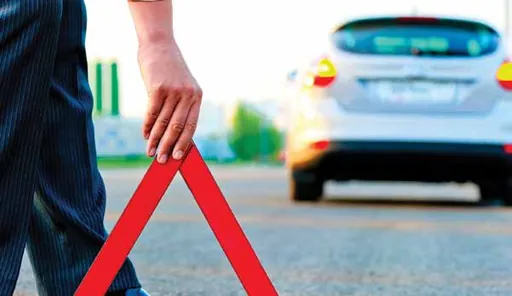
Q36.After an accident, what is the person in the picture doing to warn other traffic?
Marking the accident position for the police
Blocking the lane for the ambulance
Displaying an advance warning triangle
Measuring skid marks
Show answer
Answer C: Displaying an advance warning triangle. Warn other traffic by switching on hazard lights, displaying an advance warning triangle, or having someone direct other drivers — further collisions may happen.
Q37.Which number do you call for an ambulance in the UAE?
998
999
997
996
Show answer
Answer A: 998. 998 is for an ambulance, 999 for the police and 997 for the fire brigade.
Q38.Which number do you call for the fire brigade?
999
995
997
998
Show answer
Answer C: 997. 997 is the fire brigade; 998 ambulance; 999 police.
Q39.How can you tell the emergency services exactly where you are on a highway?
Estimate the distance from the last town
Read the location details on the yellow signs placed at intervals on the hard shoulder
Give the number of the nearest speed camera
Describe the nearest landmark
Show answer
Answer B: Read the location details on the yellow signs placed at intervals on the hard shoulder. Location details are marked on yellow signs at regular intervals on the hard shoulder; check them before calling.
Q40.What may happen if you leave the scene of an accident without giving your name and phone number?
A small fine only
Loss of insurance cover only
Disqualification from driving and a prison term
Nothing, if nobody was hurt
Show answer
Answer C: Disqualification from driving and a prison term. Leaving the scene without providing your name and telephone number is a serious offence that can lead to disqualification and prison.
Q41.You hit a parked car and cannot find the owner. What should you do?
Leave a message with your name and phone number, then notify the police
Move the parked car out of the way
Drive away; the owner’s insurance will cover it
Wait no more than 10 minutes and then leave
Show answer
Answer A: Leave a message with your name and phone number, then notify the police. Try to contact the owner; if you cannot, leave your name and telephone number and notify the police.
Q42.An accident is on the other side of the motorway. What should you do?
Stop on the hard shoulder and cross over
Slow down to check whether help is needed
Do not slow down to look; you could cause another accident on your side
Flash your lights at the vehicles involved
Show answer
Answer C: Do not slow down to look; you could cause another accident on your side. Do not slow down to look at an accident on the other carriageway — you may cause another accident or unnecessary congestion.
Q43.After an accident, what must you do about the tracks and marks on the road?
Leave them intact until the police take over
Sweep them away to reopen the road
Photograph them and then clean the road
Mark them with chalk
Show answer
Answer A: Leave them intact until the police take over. Tracks or anything that may help the inquiry must not be erased or modified; they must remain intact until the police take over.
Q44.You damage a traffic sign in an accident and cannot restore it. What must you do?
Warn other road users, then notify the police and the responsible authority
Leave a note on the sign
Remove the sign completely
Nothing; the municipality inspects signs regularly
Show answer
Answer A: Warn other road users, then notify the police and the responsible authority. Do all you can to restore a damaged sign, light or marking; if impossible, warn others, then notify the police and the maintaining authority.
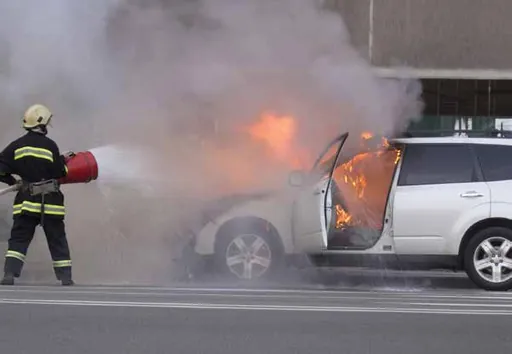
Q45.A serious fire like this breaks out in a vehicle. What should you do?
Drive the car to the nearest fire station
Tackle it with water from the radiator
Get well clear of the vehicle and leave it to the fire brigade
Open the bonnet to let the heat out
Show answer
Answer C: Get well clear of the vehicle and leave it to the fire brigade. A small fire may be put out with an extinguisher; if it appears serious do not tackle it — get everyone out and well clear, as fire spreads with alarming speed.
Q46.When may an accident casualty be moved?
Whenever they ask to be moved
To make room for traffic
As soon as an ambulance is called
Only if they could be run over by other vehicles or there is a risk of fire or explosion
Show answer
Answer D: Only if they could be run over by other vehicles or there is a risk of fire or explosion. Casualties should not be moved unless in danger from traffic, fire or explosion; do not remove a motorcyclist’s helmet unless essential.
Q47.Should you remove an injured motorcyclist’s helmet?
Yes, if they are conscious
Only if the ambulance is delayed
Not unless it is essential to do so
Yes, always, to help them breathe
Show answer
Answer C: Not unless it is essential to do so. Do not remove a motorcyclist’s helmet unless it is essential; casualties should be moved as little as possible.
Q48.When the ambulance crew arrives, what should you tell them?
Your own diagnosis of each casualty
Only your name and phone number
As many facts as you can, but no assumptions or diagnoses
Nothing; let them assess the scene
Show answer
Answer C: As many facts as you can, but no assumptions or diagnoses. Give the crew as many facts as possible, but no assumptions or diagnoses; try to remain calm.
Q49.If you are certified in first aid and come first upon an accident, what does the book urge?
Photograph the scene first
Wait for professionals; never touch a casualty
Only direct traffic
Be prepared to give first aid; it could save someone’s life
Show answer
Answer D: Be prepared to give first aid; it could save someone’s life. Perhaps a quarter of accident victims could have been saved by fellow road users giving first aid; if certified, be prepared to help.
smartphone Android app
Practise anywhere, even offline
The free Android app has the same questions, a timed mock exam, road-sign flashcards and a daily practice streak. Sign in with Google to keep it in step with this website.