Chapter 4: Driving Under Difficult Conditions — theory test questions and answers
48 practice questions for the UAE driving theory test on driving in sunshine and hot weather, driving safely in the dark, driving in fog, driving in high winds and more, each with the correct answer and a short explanation from the handbook. Try each one before you open the answer.
Q1.When should you check the air pressure in your tyres?
Before you start your journey, while the tyres are cold
After driving for a while, when the tyres are warm
Only at the petrol station after filling up
Once a year at the annual inspection
Show answer
Answer A: Before you start your journey, while the tyres are cold. Check and adjust tyre pressure before setting off when tyres are cold; warm tyres give an inaccurate reading.
Q2.Why should you keep the windscreen clear of water and grease marks?
It helps to reduce glare
It keeps the cabin cooler
It stops the wipers wearing out
It improves fuel economy
Show answer
Answer A: It helps to reduce glare. A clean windscreen reduces glare; check and top up the washer reservoir and replace worn wipers.
Q3.Why does the book advise you not to smoke while driving?
Smoking deposits a film on the windows that reduces visibility
It distracts other drivers
It is a fire risk near the fuel tank
It uses up oxygen in the cabin
Show answer
Answer A: Smoking deposits a film on the windows that reduces visibility. Smoking leaves a thin film on the car windows which reduces visibility and troubles the driver.
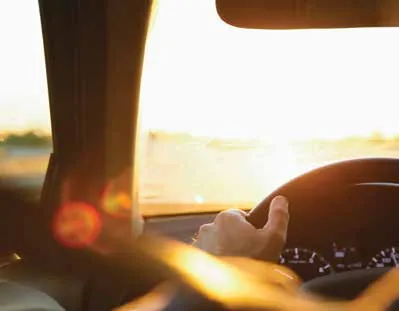
Q4.You are driving into constant low sun as pictured. What does the book recommend?
Tint the windscreen with spray
Wear correct sunglasses to reduce glare and avoid looking directly into the sun
Drive faster to get out of the sun
Switch on full-beam headlights
Show answer
Answer B: Wear correct sunglasses to reduce glare and avoid looking directly into the sun. Constant sun in the eyes is exhausting; the correct sunglasses reduce glare and keep your eyes efficient longer. Take plenty of breaks.
Q5.You feel tired on a motorway in hot weather. Where should you rest?
At a service area or after leaving the motorway
On the slip road
In the right-hand lane at low speed
On the hard shoulder with hazard lights on
Show answer
Answer A: At a service area or after leaving the motorway. Never stop on the hard shoulder when tired; use the service areas or get off the motorway.
Q6.Why is a sudden rain shower after a long dry spell particularly dangerous?
It causes tyres to overheat
Windscreen wipers do not work in heat
Oil and water make the hot road surface slippery
The rain hides road markings
Show answer
Answer C: Oil and water make the hot road surface slippery. Oil and water on a hot road create a slippery surface, especially after a long dry spell; watch your speed and keep your distance.
Q7.You must drive after a large midday meal like this in summer. What should you do?
Drink coffee and drive at normal speed
Open the windows and drive faster to stay alert
Take time to digest or sleep it off first; otherwise drive slower and take extra care
Nothing; a meal does not affect driving
Show answer
Answer C: Take time to digest or sleep it off first; otherwise drive slower and take extra care. Heat plus a large midday meal lowers energy and causes drowsiness; digest or rest first, or drive more slowly with extra care.
Q8.At 120 km/h, how much greater is the accident risk at night compared with daylight?
Up to six times greater
About the same
Up to ten times greater
About twice as great
Show answer
Answer A: Up to six times greater. The risk at night is greater; at 120 km/h it is up to six times greater, partly because our eyes are not designed for night vision.
Q9.In darkness, fog or rain, how does oncoming traffic tend to appear?
Closer than it actually is
Further away than it actually is
Faster than it actually is
Exactly as it is
Show answer
Answer B: Further away than it actually is. In poor light oncoming traffic appears further away than it is, leading to errors of judgement when passing.
Q10.What is the golden rule for speed at night?
Drive at the posted limit; lights compensate for darkness
Drive 10 km/h below the daytime limit
Never drive so fast that you cannot stop within the range of your lights
Match the speed of the vehicle ahead
Show answer
Answer C: Never drive so fast that you cannot stop within the range of your lights. If you cannot stop safely within the range of your lights, you are going too fast — this applies at dusk and dawn too.
Q11.When should you switch your lights on in the evening?
Before dusk; do not be afraid to be the first to switch on
When the street lights come on
Only when it is fully dark
When another driver flashes you
Show answer
Answer A: Before dusk; do not be afraid to be the first to switch on. Put your lights on before dusk: it is better to see and be seen. At dawn do not switch off until you are sure it is safe.
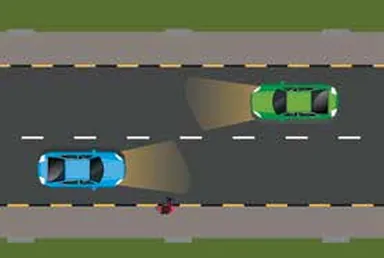
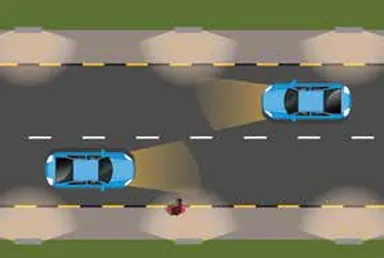
Q12.In this night scene, what must the driver do on seeing the oncoming vehicle?
Switch off the headlights briefly
Dip the headlights, and look to the right-hand side of the road
Flash full beam to warn the other driver
Keep full beam so the pedestrian stays visible
Show answer
Answer B: Dip the headlights, and look to the right-hand side of the road. Dip your headlights for any oncoming vehicle, including bicycles, and keep your eyes to the right-hand side of the road; you need not dip for pedestrians.
Q13.Do you need to dip your headlights for pedestrians?
Yes, for everyone on the road
Only in built-up areas
Only for pedestrians on the left
No, only for vehicles, including bicycles
Show answer
Answer D: No, only for vehicles, including bicycles. Dipping applies to all types of vehicle including bicycles, but you do not need to dip for pedestrians.
Q14.A bus is coming towards you at the brow of a hill at night. When should you dip?
As soon as you see its marker lights
When you can read its number plate
Only if it flashes you
When it dips its own lights
Show answer
Answer A: As soon as you see its marker lights. Drivers of large vehicles sit higher and are dazzled sooner than you are, so dip early to alert them.
Q15.When you catch up with another vehicle at night, why must you dip your headlights?
Because full beam is illegal outside towns
So the driver ahead knows you want to overtake
To save the battery
So as not to dazzle the driver in their rear-view mirror
Show answer
Answer D: So as not to dazzle the driver in their rear-view mirror. Dip when catching up so you do not dazzle the driver ahead through their mirrors; buses and lorries have large mirrors, so dip early.
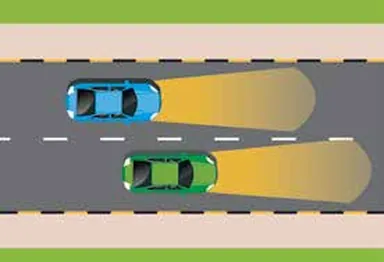
Q16.In the picture the blue car is being overtaken at night. How should it use its headlights?
Switch the lights off briefly
Flash full beam repeatedly
Dip immediately when the other car starts to overtake
Keep full beam on until the other car becomes just visible to its left
Show answer
Answer D: Keep full beam on until the other car becomes just visible to its left. When being overtaken, help by keeping full beam on as long as possible, until the other car becomes just visible to your left, so the road is lit for both.
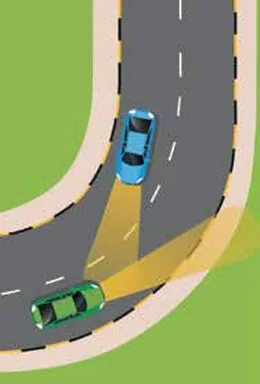
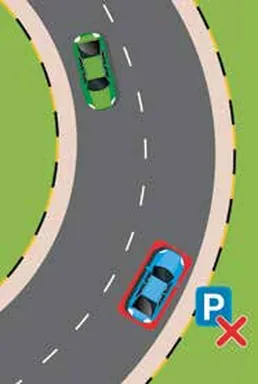
Q17.The car in the picture approaches a right-hand bend at night. When should it dip?
Earlier than usual, because its beam cuts across oncoming drivers’ eyes
Only after the apex of the bend
Later than usual, because the bend hides oncoming traffic
It need not dip at all on right-hand bends
Show answer
Answer A: Earlier than usual, because its beam cuts across oncoming drivers’ eyes. On a right-hand bend your headlights cut straight across the eyes of oncoming drivers, so dip earlier; on a sharp left-hand bend you may not need to dip at all.
Q18.Where should you position your car on the road when driving in the dark?
Exactly as in daylight
On the hard shoulder if traffic is light
As close to the edge line as possible
Closer to the centre line than during the day
Show answer
Answer D: Closer to the centre line than during the day. At night drive closer to the centre line; when meeting oncoming traffic keep halfway between centre and edge line, never on the hard shoulder.
Q19.You stop at night as pictured. What should you do with your lights?
Leave full beam on facing traffic
Leave dipped headlights on so you are seen
Switch off the headlights and use the parking lights instead
Switch on the hazard lights
Show answer
Answer C: Switch off the headlights and use the parking lights instead. Always switch off headlights when you stop, even briefly; leaving them on when parked is an offence. Use parking lights instead.
Q20.You must make an emergency stop at night. What must you set up?
Nothing if the parking lights are on
Only the hazard lights
Advance warning triangles some distance behind the car, plus hazard lights if they work
A torch on the roof
Show answer
Answer C: Advance warning triangles some distance behind the car, plus hazard lights if they work. In an emergency stop in darkness, place your warning triangles at some distance behind the car and switch on the hazard lights if the electrics still work.
Q21.In a built-up area with street lighting like this, which headlights should you use?
No lights, the street lights are enough
Dipped headlights; full beam is prohibited
Full beam, to see pedestrians
Side lights only
Show answer
Answer B: Dipped headlights; full beam is prohibited. Always use dipped headlights in built-up areas at night; where street lighting is adequate, driving on full beam is prohibited.
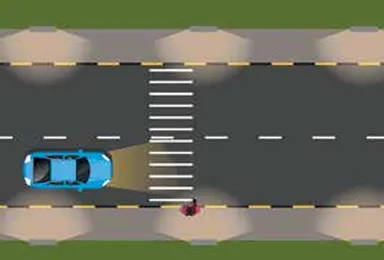
Q22.At night you approach this pedestrian crossing in a lit street. How should you drive?
At normal speed, since the crossing is lit
Sound the horn to warn pedestrians
On full beam so pedestrians see you
At a speed at which you can stop safely; expect pedestrians who think they are well lit
Show answer
Answer D: At a speed at which you can stop safely; expect pedestrians who think they are well lit. Pedestrians under street lights believe they are visible and behave as in daylight; approach crossings at a speed you can stop from.
Q23.What does the book say about behaviour like this at night?
Rev the engine to warm it up
Keep all noises to a minimum; do not rev the engine, close doors quietly
It is fine before midnight
Sound the horn to warn sleeping neighbours you are leaving
Show answer
Answer B: Keep all noises to a minimum; do not rev the engine, close doors quietly. Keep noise to a minimum at night: no revving, close doors quietly, take care with alarms — neighbours and children may be asleep.
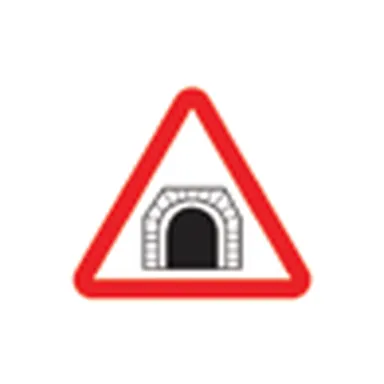
Q24.You see this sign. What must you do?
Turn on your headlights and do not stop in the tunnel
Sound the horn before entering
Reduce speed to 40 km/h
Switch to full beam
Show answer
Answer A: Turn on your headlights and do not stop in the tunnel. Tunnel ahead: switch on your headlights and no stopping inside.
Q25.When may you use high-intensity rear fog lights?
Whenever it is raining
Whenever visibility is below 500 m
Only in fog when visibility is seriously reduced; switch off when it improves
At night on unlit roads
Show answer
Answer C: Only in fog when visibility is seriously reduced; switch off when it improves. Rear fog lights are for seriously reduced visibility only; used at other times they dazzle following drivers.
Q26.Which headlights should you use when driving in fog?
Full beam, to see further
Side lights only
Hazard lights
Dipped headlights, keeping well back from the vehicle in front
Show answer
Answer D: Dipped headlights, keeping well back from the vehicle in front. Use dipped headlights in fog and keep well back; slow down and leave plenty of room for stopping.
Q27.If you must park on a road in fog, what should you do?
Leave the hazard lights on
Leave the headlights on full beam
Park facing oncoming traffic
Leave your parking or side lights on
Show answer
Answer D: Leave your parking or side lights on. Avoid parking on a road in fog; if unavoidable, always leave the parking or side lights on.
Q28.In fog, what can you use as a guide to avoid drifting into oncoming traffic?
The tail lights of the car ahead
The right edge of the road
The overhead signs
The centre line
Show answer
Answer B: The right edge of the road. There is a tendency to wander into the middle of the road in fog; use the right edge as a guide and stay in your lane.
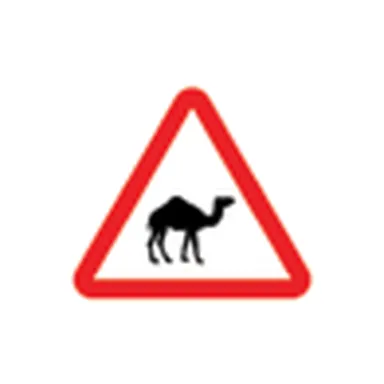
Q29.What does this sign warn of?
Wild animals (camels) may be on the road
Zoo entrance
Camel racing track ahead
Animal grid ahead
Show answer
Answer A: Wild animals (camels) may be on the road. Wild animals such as camels may wander onto the road; they are hard to see, especially in fog and at night, so slow down.
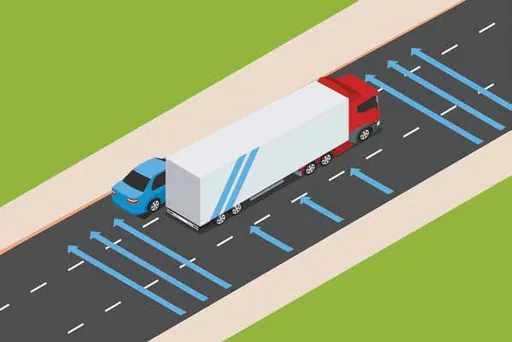
Q30.What is the danger for the blue car in this high-wind picture?
The truck’s slipstream will pull it forward
A strong gust could topple the truck onto it; do not stay alongside longer than necessary
The truck will splash it with water
The truck cannot see it in the mirrors
Show answer
Answer B: A strong gust could topple the truck onto it; do not stay alongside longer than necessary. In high winds do not stay alongside large vans or trucks longer than needed to overtake; a gust could topple a transporter onto you.
Q31.What should you do in a strong shamal (sandstorm) that obscures visibility?
Use full beam and continue
Follow the tail lights of the vehicle ahead closely
Drive on slowly with hazard lights on
Pull over and stop at the side of the road until it passes
Show answer
Answer D: Pull over and stop at the side of the road until it passes. In a strong shamal it is sensible to pull over and stop until the storm has passed and visibility is clear; then watch for sand spits on the road.
Q32.In gusty winds, why should you allow extra room when overtaking cyclists?
They cannot hear you
They will speed up
They may be blown sideways into your path
They will stop suddenly
Show answer
Answer C: They may be blown sideways into your path. Watch for cyclists and motorcyclists being blown sideways in gusts and allow extra room.
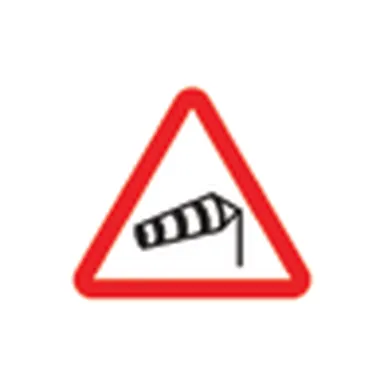
Q33.What does this warning sign mean?
Strong cross winds
Low flying aircraft
Sandstorm area
Airport ahead
Show answer
Answer A: Strong cross winds. The windsock warns of strong cross winds; keep alert for the vehicle being pushed sideways, especially high-sided vehicles.
Q34.Why does light rain make Gulf roads especially slippery?
Tyres are designed for dry roads
The dirty surface turns into a “skid pan” offering little grip
The road markings dissolve
The rain is unusually cold
Show answer
Answer B: The dirty surface turns into a “skid pan” offering little grip. Light rain turns dirty road surfaces into skid pans; less grip means longer stopping distances, so slow down and keep further back.
Q35.May you use hazard lights while driving in heavy rain?
Only on motorways
Yes, to be more visible
Yes, if driving above 80 km/h
No, hazard lights must not be used while driving in heavy rain
Show answer
Answer D: No, hazard lights must not be used while driving in heavy rain. Some drivers use hazard lights as an excuse for high-speed driving in rain; hazard lights must not be used while driving in heavy rain.
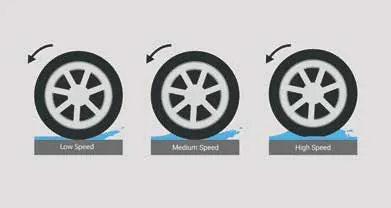
Q36.This diagram compares tyres at low, medium and high speed on a wet road. What does it show?
Low speed causes aquaplaning
At higher speed the tyre cannot drain water and aquaplanes
Tyre width does not matter on wet roads
Higher speed increases tyre grip on water
Show answer
Answer B: At higher speed the tyre cannot drain water and aquaplanes. A tyre that cannot drain water away skids on a layer of water — aquaplaning; high speed, worn treads and overly broad tyres are causes.
Q37.What is a clear sign that you are aquaplaning, and what should you do?
The car pulls left; steer right
The engine note rises; change up a gear
The steering suddenly feels very light; ease off the accelerator, do not brake or steer
The steering feels heavy; brake gently
Show answer
Answer C: The steering suddenly feels very light; ease off the accelerator, do not brake or steer. Light steering means aquaplaning; slow down by easing off the accelerator and never brake or change direction because you have no control.
Q38.At 80 km/h in rain, how much water may each tyre have to force away per second?
Up to 5 litres
Up to 100 litres
Up to 25 litres
About 1 litre
Show answer
Answer C: Up to 25 litres. At 80 km/h tyres must force away up to 25 litres of water per second; the contact patch is only about palm-sized.
Q39.How large is the contact area between a car tyre and the road?
About one square metre
About the size of a dinner plate
About the size of a sheet of paper
No larger than the palm of your hand
Show answer
Answer D: No larger than the palm of your hand. Each tyre’s contact patch is only about palm-sized, so the tread must drain water efficiently to keep grip.
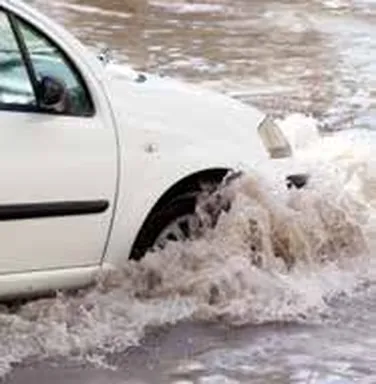
Q40.You must drive through a shallow flood like this. How should you do it?
Along the edge of the road where it is shallowest
As slowly as possible in first gear at a steady speed, keeping to the shallowest part
Fast, to avoid stalling in the water
In top gear at walking pace
Show answer
Answer B: As slowly as possible in first gear at a steady speed, keeping to the shallowest part. Stop and check the depth first; if you drive through, use first gear, slow and steady, and keep to the crown of the road, which is shallowest.
Q41.What should you do immediately after driving through flood water?
Switch off the engine to let it drain
Test your brakes and dry them by braking lightly while driving slowly
Accelerate hard to blow water out of the engine
Nothing; modern brakes are sealed
Show answer
Answer B: Test your brakes and dry them by braking lightly while driving slowly. Test the brakes after a flood; light pressure on the pedal while driving slowly helps dry them, and do not drive at normal speed until they work.
Q42.Where is flood water usually deepest on a road?
In the middle of the right lane
At the crown or centre
Near the edge, because of the road’s incline
It is the same depth everywhere
Show answer
Answer C: Near the edge, because of the road’s incline. Because of the road’s camber, water is deepest near the edge and shallowest at the crown.
Q43.In order of importance, what are the three factors that cause a skid?
The driver, the vehicle, the road conditions
The vehicle, the driver, the weather
The road conditions, the vehicle, the driver
The tyres, the brakes, the speed
Show answer
Answer A: The driver, the vehicle, the road conditions. Skids are caused, in order of importance, by the driver, the vehicle and the road conditions — skids do not just happen.
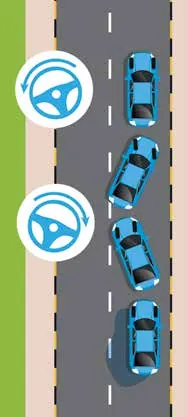
Q44.This diagram shows a car in a skid. What should the driver do with the steering?
Hold the wheel straight and brake firmly
Turn the wheel fully towards the kerb
Let the steering settle in the direction of the skid and ease off the accelerator
Steer hard against the skid
Show answer
Answer C: Let the steering settle in the direction of the skid and ease off the accelerator. In a skid: release the brake fully, release the accelerator, and let the steering settle in the direction of the skid — too much movement causes a skid the other way.
Q45.You find yourself in a skid. What should you do with the brake pedal?
Hold it halfway down
Press it harder
Pump it rapidly
Release it fully
Show answer
Answer D: Release it fully. Release the brake pedal fully; drivers instinctively keep braking, which makes matters worse.
Q46.When do brakes have their greatest stopping power?
When they are lightly applied
When they are fully locked
When they are nearly, but not quite, locked
When ABS is switched off
Show answer
Answer C: When they are nearly, but not quite, locked. Brakes stop best when nearly but not quite locked; heavy braking throws weight forward and the rear wheels lock more easily.
Q47.On wet or slippery roads, how effective is ABS?
More effective than on dry roads
Less effective; brakes are only as good as the tyre grip
Equally effective in all conditions
It switches itself off
Show answer
Answer B: Less effective; brakes are only as good as the tyre grip. ABS helps you keep steering while braking, but on wet or slippery roads it is less effective because grip is limited.
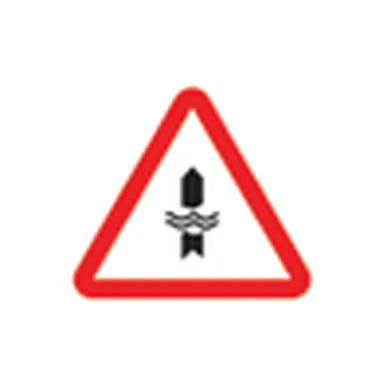
Q48.What does this warning sign indicate?
Quayside or riverbank
Slippery road
Car wash ahead
Ford ahead: the road may be flooded, check the depth before crossing
Show answer
Answer D: Ford ahead: the road may be flooded, check the depth before crossing. Ford ahead: assess the water depth before entering, and drive slowly in first gear if it is safe.
smartphone Android app
Practise anywhere, even offline
The free Android app has the same questions, a timed mock exam, road-sign flashcards and a daily practice streak. Sign in with Google to keep it in step with this website.