Chapter 3: Outside the City Limits — theory test questions and answers
55 practice questions for the UAE driving theory test on outside city limits, road works, ordinary roads, driving on motorways and more, each with the correct answer and a short explanation from the handbook. Try each one before you open the answer.
Q1.What is the maximum speed limit on the major roads in the UAE?
100 km/h
140 km/h
160 km/h
120 km/h
Show answer
Answer B: 140 km/h. The maximum on major roads is 140 km/h; inside cities it is usually 80 km/h and outside built-up areas the standard limit is 100 km/h.
Q2.What is the standard speed limit outside built-up areas?
100 km/h
120 km/h
140 km/h
80 km/h
Show answer
Answer A: 100 km/h. Outside built-up areas the standard speed limit is 100 km/h.
Q3.Hitting another vehicle at 40 km/h is compared to falling onto concrete from what height?
10 metres
20 metres
3 metres
5 metres
Show answer
Answer A: 10 metres. Even a 40 km/h impact is equivalent to falling onto a concrete floor from 10 metres.
Q4.What is the most common type of accident on main roads outside built-up areas?
Pedestrian accidents
Head-on collisions
Single-vehicle accidents
Rear-end collisions
Show answer
Answer C: Single-vehicle accidents. Because many drivers overestimate their abilities and drive too fast, single-vehicle accidents are the most common type outside built-up areas.
Q5.On which of these surfaces is the braking distance much longer?
Gravel roads compared with asphalt
New asphalt compared with old asphalt
Concrete compared with gravel
Dry asphalt compared with wet asphalt
Show answer
Answer A: Gravel roads compared with asphalt. On gravel the braking distance is much longer than on asphalt, and wet asphalt is more slippery than dry.
Q6.In which situation must you drive at an appropriately low speed?
On a straight motorway with light traffic
When approaching a bus that has stopped to set down or pick up passengers
When following a lorry at a safe distance
When being overtaken
Show answer
Answer B: When approaching a bus that has stopped to set down or pick up passengers. Low speed is required near stopped buses, at crossings, junctions, bends, hill brows, road works, slippery roads and wherever visibility is poor.
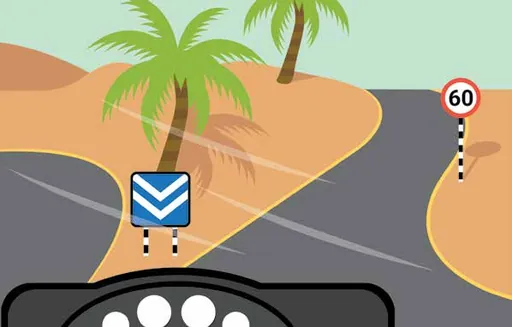
Q7.After a long motorway drive this exit sign appears. What is the danger shown?
Speed blindness: 60 km/h feels like a standstill; you may be faster than you think
The speedometer is usually wrong after motorway driving
Exit roads have no speed limit
The sign applies only to heavy vehicles
Show answer
Answer A: Speed blindness: 60 km/h feels like a standstill; you may be faster than you think. Speed blindness makes 60 km/h feel almost stationary after motorway speeds; check your speedometer, which is very seldom wrong.
Q8.About how much road does a car doing 120 km/h need to stop on a dry road?
About 35 metres
About 110 metres
About 60 metres
About 200 metres
Show answer
Answer B: About 110 metres. At 60 km/h a car needs about 35 metres to stop; at 120 km/h about 110 metres.
Q9.Why is speed blindness dangerous first and foremost?
You tend to misjudge your braking distance
You forget to use your indicators
You drive too slowly on the exit road
You cannot read road signs
Show answer
Answer A: You tend to misjudge your braking distance. Speed blindness makes you misjudge braking distance; without watching the speedometer you can be 20–30 km/h faster than you think.
Q10.What happens to your visual field as speed increases (tunnel vision)?
It widens so you see more of the road
It shifts to the left
It narrows and you fail to notice things off to the side
It stays the same but colours fade
Show answer
Answer C: It narrows and you fail to notice things off to the side. Tunnel vision narrows the visual field with increasing speed; counteract it by adapting speed and scanning all parts of the road.
Q11.How do you counteract tunnel vision when driving at high speed?
Look at the car directly in front
Use the mirrors less often
Fix your gaze far ahead on the horizon
Adapt your speed and keep shifting your gaze to scan the road
Show answer
Answer D: Adapt your speed and keep shifting your gaze to scan the road. Adapt speed to local conditions and keep shifting your gaze; scanning counteracts tunnel vision, which is also aggravated by stress.
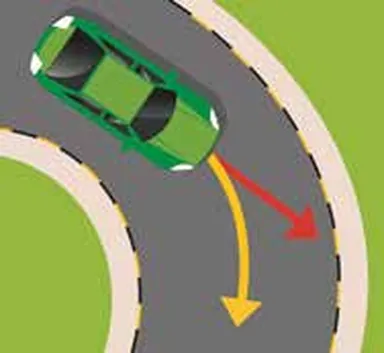
Q12.What has the driver in this picture most likely done wrong?
Changed to a lower gear before the bend
Slowed down too early before the bend
Entered the bend too fast instead of slowing down before it
Kept the wheels straight after the bend
Show answer
Answer C: Entered the bend too fast instead of slowing down before it. The secret of bends is to slow down before the bend; a bend approached too fast can feel like a sharp corner with disastrous results.
Q13.When should you increase speed again after a bend?
Only when you have straightened the wheel as you leave the bend
At the apex of the bend
As soon as you can see the exit
Halfway through the bend
Show answer
Answer A: Only when you have straightened the wheel as you leave the bend. Too much acceleration in a bend can make the wheels lose grip; increase speed only once the wheel is straightened on leaving the bend.
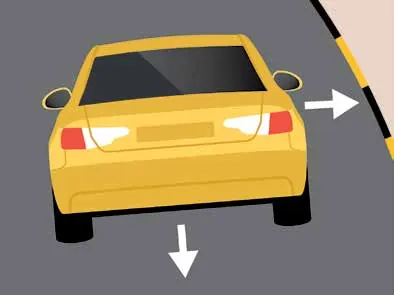
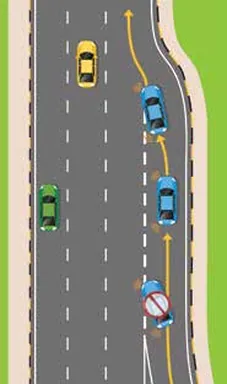
Q14.The car in the picture is starting to skid on a bend. What most likely caused it?
Slowing down before the bend
Braking or accelerating too hard in the bend
Using the accelerator lightly to keep the engine working
Changing down before the bend
Show answer
Answer B: Braking or accelerating too hard in the bend. Braking on a bend makes the vehicle unstable and likely to skid; brake before the bend, and use the accelerator only enough to drive round it.
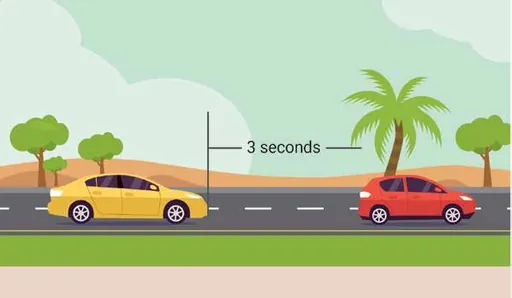
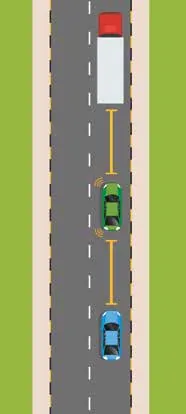
Q15.In the picture the cars are using the three-second rule. How is it applied?
Keep 3 metres per 10 km/h behind the car ahead
Wait three seconds before moving off at a junction
Count three seconds from when the car ahead passes a fixed point until you pass it
Stay three car lengths behind at any speed
Show answer
Answer C: Count three seconds from when the car ahead passes a fixed point until you pass it. Choose a reference point; when the car ahead passes it, count one hundred and one … one hundred and three. If you reach it sooner you are too close.
Q16.At 80 km/h, how far will you travel during a normal one-second reaction time?
44 metres
33 metres
17 metres
22 metres
Show answer
Answer D: 22 metres. In one second of reaction time you cover 17 m at 60 km/h, 22 m at 80 km/h and 33 m at 120 km/h.
Q17.If you raise your average speed from 80 to 100 km/h, how much time do you save over the next 10 km?
About 5 minutes
About 10 minutes
About 30 seconds
About 1 minute
Show answer
Answer D: About 1 minute. Driving faster saves as little as 1 minute over 10 km, while creating unnecessary stress and accidents.
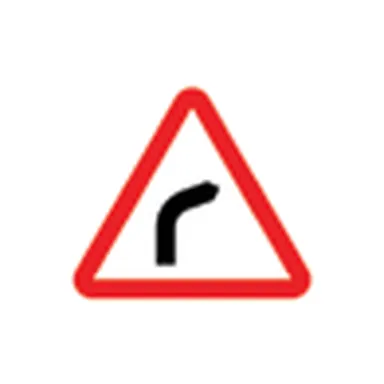
Q18.You see this sign. What should you do?
Keep right, dual carriageway ends
Prepare to turn right at the next junction
Slow down before the right-hand bend and use the accelerator lightly through it
Brake in the bend to keep control
Show answer
Answer C: Slow down before the right-hand bend and use the accelerator lightly through it. This warns of a right-hand bend: reduce speed before entering, avoid braking in the bend, and accelerate only when the wheel is straight again.
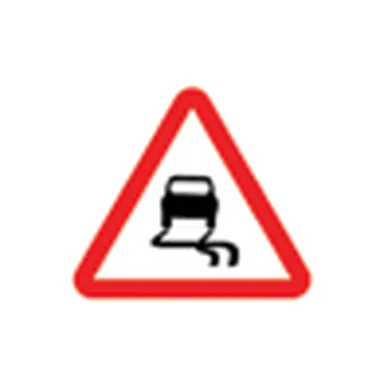
Q19.What does this warning sign mean?
Loose gravel or chippings
Slippery road
Double bend ahead
Uneven road
Show answer
Answer B: Slippery road. This is the slippery road warning; reduce speed and avoid harsh braking or acceleration.
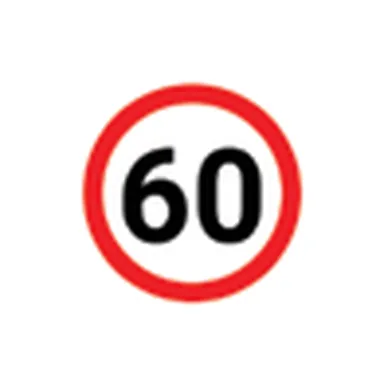
Q20.What does this red-bordered circular sign mean?
Minimum speed 60 km/h
Recommended speed 60 km/h
Maximum speed 60 km/h until another sign changes the limit
Distance 60 m to the junction
Show answer
Answer C: Maximum speed 60 km/h until another sign changes the limit. Maximum speed signs apply until another sign imposes a different limit.
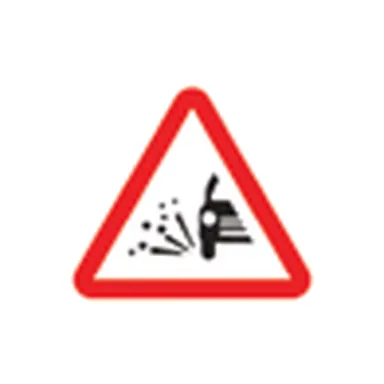
Q21.What hazard does this sign warn of?
Loose gravel or chippings
Uneven road
Slippery road
Falling rocks
Show answer
Answer A: Loose gravel or chippings. Loose gravel or chippings: braking distance is much longer than on asphalt, so slow down and keep your distance.
Q22.Before setting out on a long journey, what should you be able to do with your car?
Have it fully serviced by a mechanic every time
Wash it so the number plates are visible
Fill the tank completely
Carry out a systematic check, taking into account the weather, destination and road state
Show answer
Answer D: Carry out a systematic check, taking into account the weather, destination and road state. You must be able to carry out a systematic check of your car before setting out, considering the weather, your destination and the road; the driver’s manual gives guidance.
Q23.How should you behave when approaching a road works site?
Keep your speed but sound the horn to warn workers
Slow down in good time and keep well clear of the works
Use hazard lights while passing
Speed up to clear the site quickly
Show answer
Answer B: Slow down in good time and keep well clear of the works. Road workers work under pressure; show consideration by slowing down early and keeping well clear of the site.
Q24.You are waiting to turn onto a major road. At least how far away should an oncoming car be before you go?
At least 100 metres
At least 50 metres
At least 500 metres
At least 300 metres
Show answer
Answer D: At least 300 metres. Turning onto the road takes 5–6 seconds, in which a car at 80 km/h closes about 120 m; wait unless the oncoming car is at least 300 m away.
Q25.A car approaching from the left has its right indicator on. Should you pull out in front of it?
Yes, the indicator means it will turn before reaching you
Yes, if it is more than 50 metres away
No, remain where you are until you know it is safe; indicators can be wrong
Only if you flash your headlights first
Show answer
Answer C: No, remain where you are until you know it is safe; indicators can be wrong. Do not trust an indicator: drivers forget them or turn them on by mistake, and an indicating vehicle may hide another behind it.
Q26.What is the hard shoulder primarily for?
A safety zone and refuge for broken-down vehicles
Overtaking slow traffic on the right
Parking outside built-up areas
Cycling and walking
Show answer
Answer A: A safety zone and refuge for broken-down vehicles. The hard shoulder is a safety zone for broken-down vehicles; never use it at night or in poor light, and parking on it is prohibited.
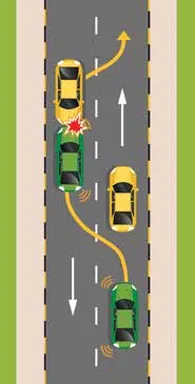
Q27.What does this picture show about overtaking with an oncoming vehicle in view?
The overtaking driver has misjudged the meeting point and risks a head-on collision
The oncoming car must pull onto the shoulder
Overtaking is safe because the road is straight
The overtaken car should speed up
Show answer
Answer A: The overtaking driver has misjudged the meeting point and risks a head-on collision. The brain is poorly equipped to judge distance, oncoming speed and overtaking distance together; misjudging the meeting point can end in a head-on crash.
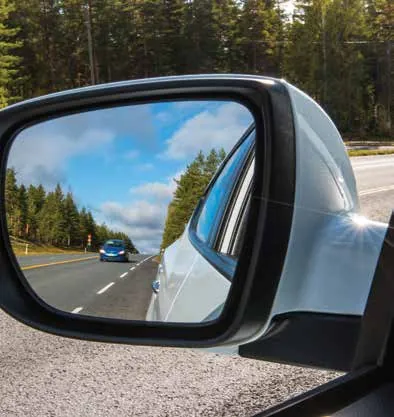
Q28.Before starting to overtake, what must you check besides this mirror?
The speedometer only
The blind spot, then switch on the indicator
Only the centre mirror
The fuel gauge
Show answer
Answer B: The blind spot, then switch on the indicator. Check the road, the centre and side mirrors, then the blind spot, then indicate, check the road again and start overtaking.
Q29.Another driver is overtaking you. What should you do?
Move to the centre line to protect your lane
Keep as far right as possible and do not speed up
Speed up so they finish sooner
Flash your headlights
Show answer
Answer B: Keep as far right as possible and do not speed up. Help the other driver by keeping right and not speeding up; speeding up prolongs the overtaking and creates risk.
Q30.In stage 3 of overtaking, when should the blue car move back into the right-hand lane?
Immediately after passing, to clear the left lane
When it can see the overtaken vehicle in its centre mirror, using the right indicator
As soon as it is level with the overtaken vehicle’s front bumper
When the overtaken vehicle flashes its lights
Show answer
Answer B: When it can see the overtaken vehicle in its centre mirror, using the right indicator. Do not move back to the right until you see the overtaken vehicle in your centre mirror, and use your right indicator.
Q31.While actually passing another vehicle, where should you look?
At the road ahead, not at the vehicle you are passing
At the speedometer
At the vehicle you are passing, to judge the gap
In the rear-view mirror
Show answer
Answer A: At the road ahead, not at the vehicle you are passing. Do not look at the other vehicle while overtaking; you may steer in the direction you are looking. Avoid sudden swerves.
Q32.In stage 1 of overtaking, which indicator do you switch on?
Both, as hazard lights
The left-hand indicator
No indicator until you pull back in
The right-hand indicator
Show answer
Answer B: The left-hand indicator. After checking mirrors and blind spot, switch on the left indicator to move out; the right indicator is used to return.
Q33.In which case is overtaking prohibited?
If you are on a primary road
If, after overtaking, you would be unable to move back into the right-hand lane
If the vehicle ahead is a lorry
If the road has two lanes in your direction
Show answer
Answer B: If, after overtaking, you would be unable to move back into the right-hand lane. Overtaking is prohibited when the lane is blocked, when crossing the centre line with oncoming traffic, when the vehicle ahead signals left, when a vehicle behind is overtaking, or when you cannot return to the right lane.
Q34.On a road with one lane in each direction, when is crossing the centre line to overtake prohibited?
At any time
Only if the line is broken
If there is traffic coming from the other direction
Only at night
Show answer
Answer C: If there is traffic coming from the other direction. On single-lane-each-way roads, crossing the centre line is prohibited when there is oncoming traffic.
Q35.About how far before a turn off a major road should you signal and take up position?
1 kilometre
300 to 400 metres
50 to 100 metres
Just before the turn
Show answer
Answer B: 300 to 400 metres. Use the mirror in good time, then signal and move into position some 300 to 400 metres before the turn.
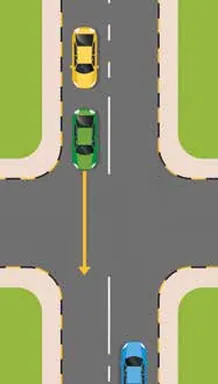
Q36.The blue car is stopped, waiting to turn left. Why should its front wheels point straight ahead?
So it can turn right instead if needed
So the indicator cancels correctly
If hit from behind it will not be pushed into the oncoming lane
To save fuel while waiting
Show answer
Answer C: If hit from behind it will not be pushed into the oncoming lane. Stop a few metres before the junction with wheels straight; if rear-ended with wheels turned left you could be forced into oncoming traffic.
Q37.Who does the law hold solely responsible for accidents involving a left turn and vehicles from behind?
The driver coming up from behind
The driver who attempted to make the turn
Both drivers equally
The driver travelling faster
Show answer
Answer B: The driver who attempted to make the turn. About two thirds of left-turn junction accidents involve vehicles from behind, and the law places sole responsibility on the turning driver.
Q38.You need to stop on a main road. What does this picture recommend?
Pull up at a lay-by or parking place spaced along the road
Stop on the carriageway with hazard lights on
Stop on the left-hand side of the road
Stop on the hard shoulder at night
Show answer
Answer A: Pull up at a lay-by or parking place spaced along the road. Preferably stop at one of the special lay-bys; a car parked on a main road is always a potential hazard, and parking on primary roads outside built-up areas is prohibited.
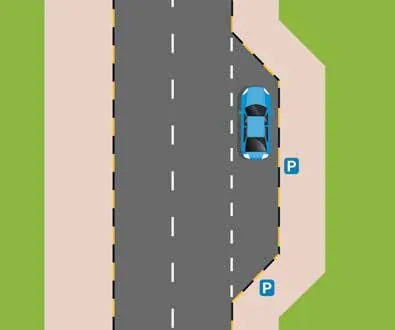
Q39.Your car breaks down on a main road. What should you set out?
Two flares behind the car
A red flag on the aerial
Nothing; hazard lights are enough
Your triangular warning sign
Show answer
Answer D: Your triangular warning sign. If your car breaks down, pull over as far right as possible and set out your triangular warning sign.
Driving a vehicle designed for speeds below 60 km/h
Show answer
Answer D: Driving a vehicle designed for speeds below 60 km/h. On a motorway it is prohibited to drive vehicles designed for less than 60 km/h, to stop, park, reverse, turn around, walk or cycle.
Q41.Why are motorway accidents usually more serious even though motorways are statistically safer?
There are no emergency services on motorways
Drivers are less experienced
They occur at higher speeds and involve more vehicles
Motorways have sharper bends
Show answer
Answer C: They occur at higher speeds and involve more vehicles. Motorway accidents happen at higher speed and involve more vehicles, so injuries and loss of life are greater.
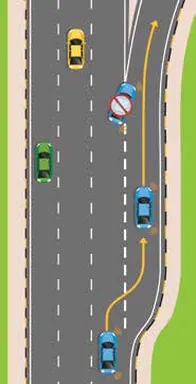
Q42.The blue car is joining the motorway from the slip road. What must it do?
Stop at the end of the slip road and wait for a gap
Join the left-hand lane where traffic is faster
Match motorway speed, give priority to motorway traffic, join a gap in the right lane
Sound the horn and merge; motorway traffic must make room
Show answer
Answer C: Match motorway speed, give priority to motorway traffic, join a gap in the right lane. Adjust your speed to the motorway traffic before joining, give priority to traffic already on the motorway, and join a suitable gap in the right-hand lane.
Q43.On a motorway, what gap should you leave to the vehicle ahead?
At least 20 metres at any speed
At least one metre for each km/h of your speed
Half a metre for each km/h of your speed
Two car lengths
Show answer
Answer B: At least one metre for each km/h of your speed. Leave at least one metre per km/h of speed (check with the three-second rule) and at least two chevrons where painted.
Q44.How many chevron markings should you keep between you and the vehicle in front on a motorway?
At least four
At least one
At least three
At least two
Show answer
Answer D: At least two. Where chevrons are painted on the motorway, keep at least two between you and the vehicle in front.
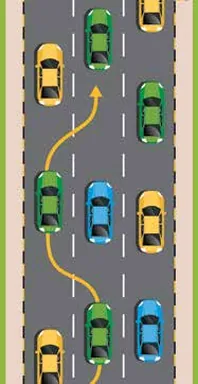
Q45.What is wrong with the driving shown in this picture?
Keeping the vehicle in the centre of the lane
Driving in the right-hand lane
Overtaking on the left
Repeatedly changing lanes; keep to a right-hand lane and change only when needed
Show answer
Answer D: Repeatedly changing lanes; keep to a right-hand lane and change only when needed. Maintain strict lane discipline: avoid repeatedly changing lanes, keep steady in your lane and do not wander into another lane.
Q46.What is the left-hand lane of a motorway for?
Vehicles travelling above 100 km/h
Fast drivers who wish to stay there
Overtaking only; return right as soon as it is safe
Heavy vehicles
Show answer
Answer C: Overtaking only; return right as soon as it is safe. The left lane is for overtaking, not a “fast lane”; return to the right-hand lane as soon as safe.
Q47.What problem does “hogging the fast lane” cause?
It wears out the left lane surface
It is not a problem if you drive at the limit
It reduces fuel economy
It forces faster drivers behind to overtake on the wrong side
Show answer
Answer D: It forces faster drivers behind to overtake on the wrong side. Drivers who stay in the fast lane ignore faster traffic behind and force them to overtake on the wrong side; complete your overtake and return.
Q48.The blue car is leaving the motorway. What is the correct way shown?
Cut across from the second lane at the last moment
Slow down on the hard shoulder first
Move right two lanes at once
Get into the right-hand lane in plenty of time and move onto the slip road
Show answer
Answer D: Get into the right-hand lane in plenty of time and move onto the slip road. Leave from the right-hand lane onto the slip road; get into lane early, one lane at a time, and never cut across at the last moment.
Q49.You miss your motorway exit. What should you do?
Carry on to the next exit
Make a U-turn at the next gap in the barrier
Reverse carefully along the hard shoulder
Stop and wait for a gap to reverse
Show answer
Answer A: Carry on to the next exit. If you miss your exit, carry on to the next one; stopping, reversing and U-turns are prohibited on motorways.
Q50.May you queue or drive on the hard shoulder to reach a motorway exit?
Yes, at walking pace
Only in daylight
No, the hard shoulder is not an exit road; use it only for emergencies
Yes, if the queue on the carriageway is long
Show answer
Answer C: No, the hard shoulder is not an exit road; use it only for emergencies. The hard shoulder is not an exit road; never queue or drive on it, though you may pull over there in an emergency.
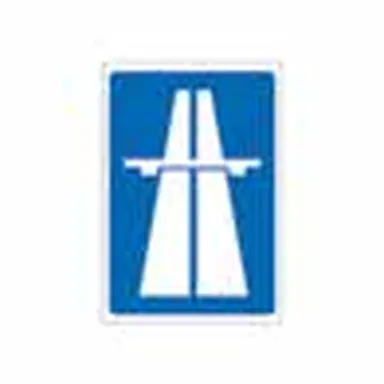
Q51.What does this sign indicate?
End of motorway
Primary road
Motor vehicles only
Beginning of motorway
Show answer
Answer D: Beginning of motorway. This is the beginning-of-motorway sign; motorway rules apply from here (no stopping, parking, reversing, U-turns, walking or cycling).
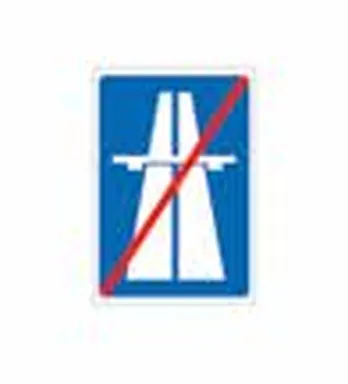
Q52.What does this sign indicate?
End of motorway: the road you are joining has different rules
No motor vehicles
Motorway closed ahead
No overtaking on the motorway
Show answer
Answer A: End of motorway: the road you are joining has different rules. End of Motorway signs are placed at all exits; expect different rules and oncoming traffic on the road you join.
Q53.What does this blue circular sign mean?
Recommended speed 60 km/h
Maximum speed 60 km/h
Minimum speed 60 km/h
End of 60 km/h limit
Show answer
Answer C: Minimum speed 60 km/h. A blue circle with a number is a mandatory minimum speed sign; the red-bordered circle is the maximum speed limit.
Q54.When driving off-road on sand dunes, why should you never travel alone?
Because it is illegal to drive alone off-road
So one driver can navigate
To share fuel between vehicles
If one vehicle gets stuck the other can still travel to get help
Show answer
Answer D: If one vehicle gets stuck the other can still travel to get help. Always travel with at least one other vehicle so help is at hand; also inform family or friends of your plans.
Q55.Do the normal speed limits and driving rules apply on dirt roads?
Yes, they are no different from highways in that respect
No, dirt roads have no speed limits
Only when the road is signposted
Only the speed limits apply
Show answer
Answer A: Yes, they are no different from highways in that respect. Despite their lower standard, dirt roads are no different from highways in speed limits and normal driving rules.
smartphone Android app
Practise anywhere, even offline
The free Android app has the same questions, a timed mock exam, road-sign flashcards and a daily practice streak. Sign in with Google to keep it in step with this website.