Chapter 2: Inside the City Limits — theory test questions and answers
44 practice questions for the UAE driving theory test on inside the city limits, using your eyes and other senses, lanes, overtaking and crossing junctions inside the city limits and more, each with the correct answer and a short explanation from the handbook. Try each one before you open the answer.
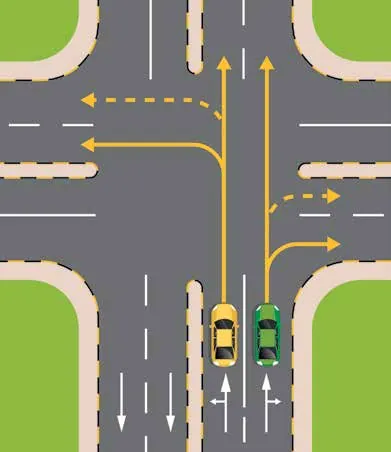
Q1.In the picture, which lane should you choose to turn left at the junction?
The right-hand lane, then cut across at the junction
The middle lane, because it allows both directions
Any lane, then follow the arrows painted at the stop line
The left-hand lane best suited to you, chosen in plenty of time
Show answer
Answer D: The left-hand lane best suited to you, chosen in plenty of time. To turn left choose the left-hand lane best suited to you well in advance; the lane arrows help you choose and avoid last-second lane changes.
Q2.What is described as the one sure way to avoid a collision when several lanes lead the same way?
Drive in the middle lane wherever possible
Change lanes early and often to keep moving
Take the straightest path through the junction
Keep to your lane at all times, following its marked course
Show answer
Answer D: Keep to your lane at all times, following its marked course. Keep to your lane and follow its course as marked, even if a straighter path looks more convenient.
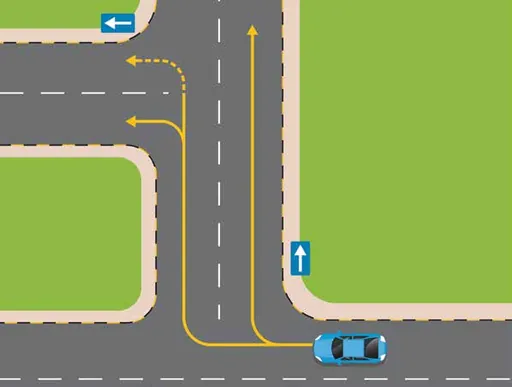
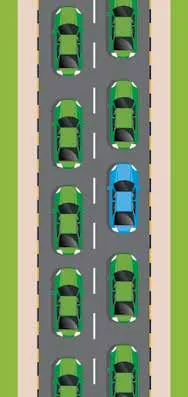
Q3.The blue car wants to turn left from this one-way street. Where should it be positioned?
Near the centre of the street
As far to the left as possible
In the right lane, indicating left
As far to the right as possible
Show answer
Answer B: As far to the left as possible. On a one-way street you turn left from as far to the left as possible, unlike on a two-way road where you keep near the centre line.
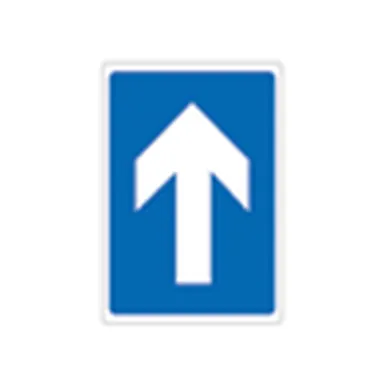
Q4.What does this sign, erected at the beginning of a block, tell you?
Priority road ahead
Beginning of a motorway
Ahead only at the next junction
One-way traffic: you may drive only in one direction
Show answer
Answer D: One-way traffic: you may drive only in one direction. The one-way traffic sign is posted at the beginning of the block and applies until the next junction.
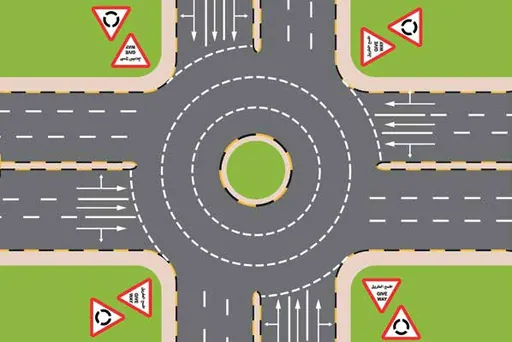
Q5.In this roundabout picture, who must give way?
Whoever is travelling faster goes first
All approaching vehicles give way to those already on the roundabout
Vehicles on the roundabout give way to those entering
Vehicles entering from the right have priority
Show answer
Answer B: All approaching vehicles give way to those already on the roundabout. All approaching vehicles must give way to vehicles already on the roundabout, which greatly reduces collision risk.
Q6.How do you signal that you are about to leave a roundabout?
Flash the right-hand indicator
Flash the left-hand indicator
Switch on the hazard lights briefly
Sound the horn once
Show answer
Answer A: Flash the right-hand indicator. Always signal your intention to leave the roundabout with the right indicator.
Q7.What does this blue circular sign mean?
Traffic merging from the left
Roundabout ahead, slow down
No U-turn
Roundabout: mandatory direction around the island
Show answer
Answer D: Roundabout: mandatory direction around the island. The blue circular sign is a mandatory roundabout sign; the red triangle version is the warning that a roundabout is ahead.
Q8.Which lane should you use before, during and when leaving a roundabout?
Move to the inner lane on entering
Maintain the same lane throughout
Use whichever lane is empty
Move to the outer lane on entering
Show answer
Answer B: Maintain the same lane throughout. Maintain the same lane before, during and when exiting the roundabout; to turn right use the right lane, to turn left move to the left lane beforehand.
Q9.This sign is posted at the end of a one-way street. What does it mean?
No motor vehicles
No stopping
No entry: traffic must not enter in this direction
One-way traffic in your direction
Show answer
Answer C: No entry: traffic must not enter in this direction. A No Entry sign is posted to prevent traffic entering a one-way street in the wrong direction.
Q10.Which part of your vision lets you discover things, and which lets you recognise them?
Night vision discovers; day vision recognises
Peripheral vision discovers; central vision recognises
Both discover; neither recognises
Central vision discovers; peripheral vision recognises
Show answer
Answer B: Peripheral vision discovers; central vision recognises. Peripheral vision enables you to discover things while the central field, where objects are in focus, lets you recognise them.
Q11.What proportion of the information you need to manage your car in traffic comes from your eyes?
99%
50%
90%
75%
Show answer
Answer C: 90%. Your eyes provide about 90% of all the information you need to manage your car in traffic.
Q12.How do experienced drivers use their eyes differently from novices?
They look mainly in the mirrors
They keep their eyes fixed on the car ahead
They focus on stationary objects close to the car
They use peripheral vision better and scan the road more systematically
Show answer
Answer D: They use peripheral vision better and scan the road more systematically. Experienced drivers make better use of peripheral vision and scan systematically; novices concentrate on stationary objects near their own vehicle.
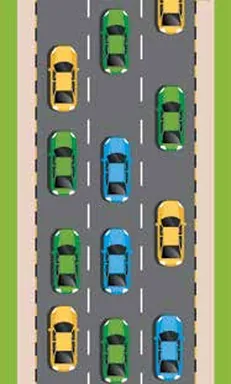
Q13.Why do collisions frequently occur in a queue like the one pictured?
Vehicles keep too large a gap
Drivers look too far ahead
Vehicles drive too fast or too close and cannot brake in time
Drivers use the horn too often
Show answer
Answer C: Vehicles drive too fast or too close and cannot brake in time. In congested conditions pile-ups happen because vehicles are too fast or too close to brake in time; look well ahead and watch the stop lights of cars further up.
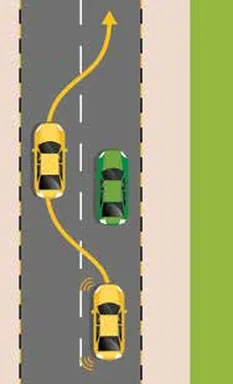
Q14.The yellow car wants to change lanes as shown. When may a driver change lanes?
Only when it can be done safely without unnecessary hindrance to others
Whenever the indicator has been on for three seconds
Only where a broken line is longer than the gap
Only at junctions
Show answer
Answer A: Only when it can be done safely without unnecessary hindrance to others. Drivers may change lanes only if they can do so safely and without causing unnecessary hindrance to other road users.
Q15.You notice another driver wants to enter your lane. What should you do?
Close the gap so they wait for the next one
Adjust your speed and leave plenty of space to let them in
Flash your headlights to refuse
Sound the horn
Show answer
Answer B: Adjust your speed and leave plenty of space to let them in. A driver who sees another road user wishing to enter the lane should facilitate it by adjusting speed and leaving space.
Q16.What does a prohibitory (continuous) line between two lanes mean?
Slow down before the junction
You may change lanes with care
Do not change lanes
Overtake only on the right
Show answer
Answer C: Do not change lanes. A prohibitory line separating two lanes means do not change lanes; move over well before such lines.
Q17.The blue car passes on the right in this congestion. Is that permissible?
Only if the horn is sounded first
Only outside city limits
Yes, in congested traffic where the right lane is open
No, passing on the right is never allowed
Show answer
Answer C: Yes, in congested traffic where the right lane is open. Passing on the right is permitted in congested traffic where the right lane is open, where overhead signs show lanes to different destinations, and where drivers keep their correct lanes before a junction.
Q18.The vehicle ahead has clearly indicated it is about to turn left. May you pass it on the right?
Only on a one-way street
No, you must wait behind it
Only if it has stopped completely
Yes, you may pass on the right a vehicle clearly indicating a left turn
Show answer
Answer D: Yes, you may pass on the right a vehicle clearly indicating a left turn. You may pass on the right-hand side a vehicle that has clearly indicated it is about to turn left.
Q19.Just before you turn the wheel to change lanes, what should you check?
The lane arrows painted on the road
Only the rear-view mirror
The speedometer
Your side mirror and a quick glance over your shoulder for the blind spot
Show answer
Answer D: Your side mirror and a quick glance over your shoulder for the blind spot. Before moving over, check the side mirror and glance over your shoulder for vehicles hidden in the blind spot, then move smoothly while accelerating gently.
2.4 Overtaking and crossing junctions inside the city limits
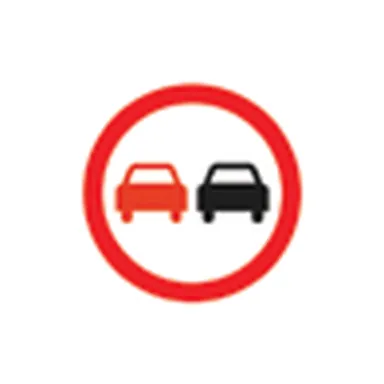
Answer A: Overtaking. This prohibitive sign means no overtaking; overtaking is also prohibited by rule at junctions and where the view is obstructed.
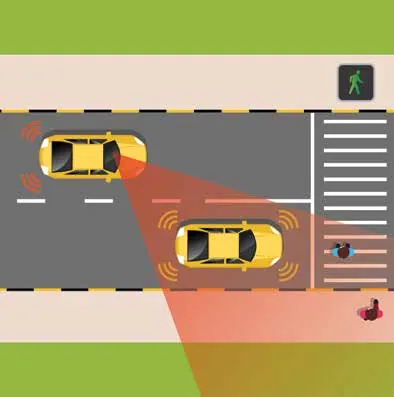
Q21.What is dangerous about the overtaking manoeuvre in this picture?
The car being overtaken has no lights on
Both cars are exceeding the speed limit
Overtaking at a pedestrian crossing hides pedestrians from view and is prohibited
Overtaking on the right is never allowed
Show answer
Answer C: Overtaking at a pedestrian crossing hides pedestrians from view and is prohibited. Overtaking where the view is obstructed, and at crossings and junctions, is prohibited; a car that has stopped for a pedestrian hides the pedestrian from the overtaking driver.
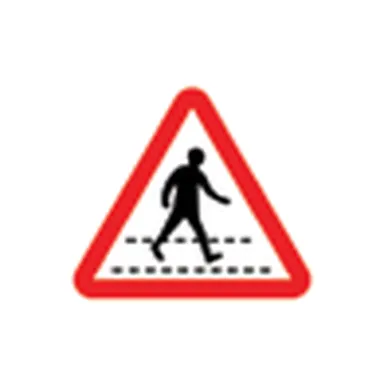
Q22.You see this sign. What should you expect and do?
A school ahead: sound the horn
A pedestrian crossing ahead: slow down and do not overtake
Pedestrians prohibited beyond this point
A footpath ends: pedestrians will join the road
Show answer
Answer B: A pedestrian crossing ahead: slow down and do not overtake. This warning sign announces a pedestrian crossing; overtaking there is prohibited and you must give way to pedestrians on or stepping onto the crossing.
Q23.You suspect a pedestrian near the road has a disability. What should you do?
Sound the horn to warn them
Stop only if they use a white cane
Slow down in plenty of time and be prepared to give way
Keep your speed but move to the far lane
Show answer
Answer C: Slow down in plenty of time and be prepared to give way. Disabilities may be invisible; if you suspect someone is challenged, slow down early and be prepared to give way.
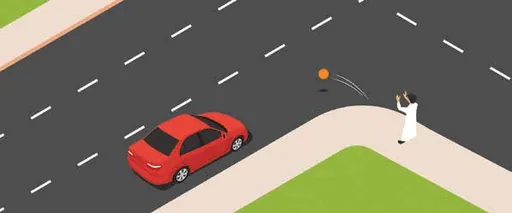
Q24.A ball rolls into the road ahead as in the picture. What should you expect?
Nothing; the ball will roll clear
Only that you should avoid hitting the ball
A child may run out after it; slow down and be ready to stop
A dog to follow the ball
Show answer
Answer C: A child may run out after it; slow down and be ready to stop. Children act on impulse and often run rather than walk; watch out for the ball, watch out for the child.
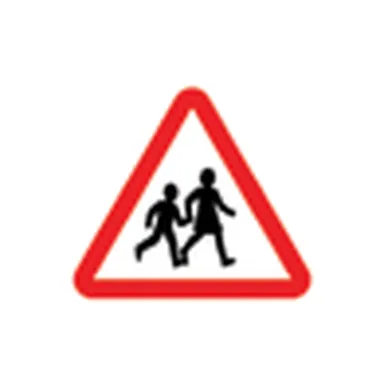
Q25.What does this warning sign tell you?
Children may be on the road ahead
School zone: no stopping
Playground: 20 km/h limit
Pedestrian crossing ahead
Show answer
Answer A: Children may be on the road ahead. The children sign warns of children near the road; children are unpredictable and difficult to see, so treat them as living warning signs.
Q26.Until roughly what age is a young person’s eyesight not fully developed?
Around fifteen
Around eighteen
Around six
Around nine
Show answer
Answer A: Around fifteen. A child’s eyesight is not fully developed until around age fifteen, so their visual field is limited.
Q27.At what age do children become reasonable and safe in traffic?
9–12 years old
13–15 years old
5–7 years old
16–18 years old
Show answer
Answer A: 9–12 years old. Children do not become reasonable and safe in traffic until they are 9–12 years old and are poor judges of speed and distance.
Q28.Besides signalling, how can you warn drivers behind that you are about to stop?
Flash the headlights
Sound the horn twice
Switch on the hazard lights
Press the brake pedal gently several times
Show answer
Answer D: Press the brake pedal gently several times. In addition to the correct signal, press the brake pedal gently several times so drivers behind have time to react.
Q29.On which side of the road should you normally stop or park?
On whichever side is closer
On the right-hand side
On the left-hand side
On the pavement if there is room
Show answer
Answer B: On the right-hand side. As a general rule stop or park on the right-hand side; stopping or parking on the pavement is strictly prohibited.
Q30.You have pulled up and are sitting behind the wheel with the engine running. What is this called?
Loading
Parking
Waiting
Stopping
Show answer
Answer C: Waiting. Pulling up is stopping; remaining behind the wheel (engine on or off) is waiting; leaving the car is parking.
Q31.When parking downhill, which way should you turn the front wheels?
Straight ahead, with the handbrake off
Away from the curb, and leave the car in first gear
Away from the curb, in neutral
Towards the curb, and leave the car in reverse gear
Show answer
Answer D: Towards the curb, and leave the car in reverse gear. Downhill: front wheels towards the curb and reverse gear; uphill: wheels away from the curb and first gear, so the car cannot roll if the parking brake fails.
Q32.Within what distance of a junction or pedestrian crossing is stopping and waiting prohibited?
10 metres
25 metres
15 metres
5 metres
Show answer
Answer C: 15 metres. Stopping and waiting is prohibited within 15 metres of a junction, crossing or pedestrian crossing.
Q33.In which of these places is stopping and waiting prohibited?
In a marked parking bay
In an underpass or tunnel
On the right-hand side of a straight road
Outside a shop for a short time
Show answer
Answer B: In an underpass or tunnel. Stopping and waiting is prohibited in underpasses and tunnels, on or near bends, at the brow of a hill, at T-junctions and where you might hide a sign or light.
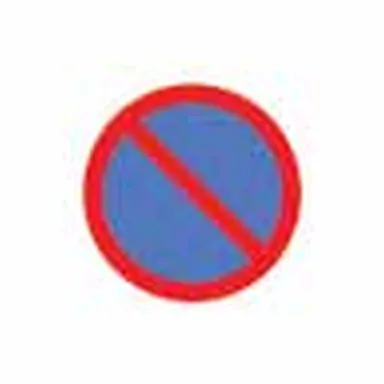
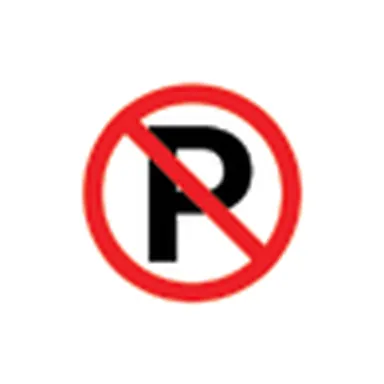
Q34.What does this sign mean?
No overtaking
No parking: you may stop briefly to pick up or drop off passengers or goods
No stopping: you may not stop at all
No entry
Show answer
Answer B: No parking: you may stop briefly to pick up or drop off passengers or goods. A Parking Prohibited sign still lets you stop to pick up or set down passengers or goods, but without unnecessary delay.
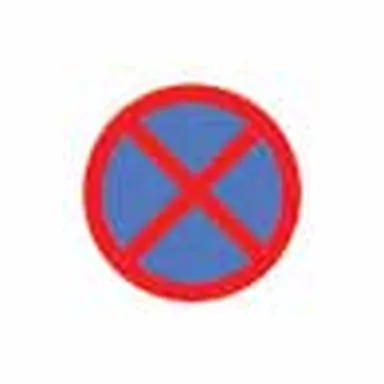
Q35.What does this sign mean?
Road closed
No U-turn
No parking, but brief stops to drop off passengers are allowed
No stopping and no parking: both are strictly prohibited
Show answer
Answer D: No stopping and no parking: both are strictly prohibited. Where the No Stopping or Parking sign is posted, stopping and parking are both strictly prohibited.
Q36.Who may park in a space marked with a Disabled Persons sign?
Taxis and ambulances only
Anyone dropping off a disabled passenger
Anyone for less than 10 minutes
Only disabled persons holding special permits
Show answer
Answer D: Only disabled persons holding special permits. Only disabled persons holding special permits may park in spaces marked with the Disabled Persons sign.
Q37.In which of these places is parking prohibited?
Alongside another parked vehicle
In a marked bay with all tyres inside the lines
On the right-hand side of a two-way road
More than 15 metres from a junction
Show answer
Answer A: Alongside another parked vehicle. Parking is prohibited alongside another parked vehicle, at bus stops, in front of fire hydrants, where you block access to a site, and with tyres on the marking lines.
Q38.From which lane must a U-turn be made at a junction that allows it?
The left lane
Any lane, provided you signal
The right lane
The middle lane
Show answer
Answer A: The left lane. U-turns are made from the left lane, and you must give way to all oncoming traffic.
Q39.At a designated U-turn site, to whom must you give way?
All oncoming traffic
Only vehicles turning right
Only heavy vehicles
Nobody, the site gives you priority
Show answer
Answer A: All oncoming traffic. Even at designated U-turn sites you must give way to all oncoming traffic.
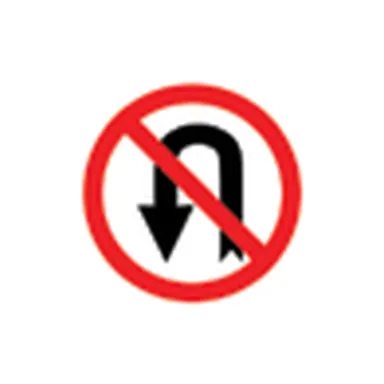
Q40.What does this sign mean?
No U-turn
No overtaking
No left turn
U-turn permitted from the left lane
Show answer
Answer A: No U-turn. This prohibitive sign forbids U-turns; it applies until the next junction unless a supplementary sign says otherwise.
Q41.If you must reverse to turn around, into which road should you reverse?
Into the road with better visibility
Into the minor road
Into the main road
Into whichever road is wider
Show answer
Answer B: Into the minor road. Always reverse into the minor road, where others can see you clearly, and watch out for children when reversing.
Q42.Traffic is heavy and fast and you need to turn around. What should you do?
Use a designated U-turn site or drive on to a more suitable location
Reverse into the main road
Make a U-turn from the right lane where there is a gap
Stop in the left lane with hazard lights and wait for a gap
Show answer
Answer A: Use a designated U-turn site or drive on to a more suitable location. Where traffic is heavy and fast, change direction at a designated U-turn site or keep going to a more suitable location.
Q43.You want to drop off a passenger where this sign is posted. May you?
Only if the hazard lights are on
Yes, briefly and without unnecessary delay
No, you may not stop for any reason
Only between midnight and 6 am
Show answer
Answer B: Yes, briefly and without unnecessary delay. A Parking Prohibited sign allows a brief stop to pick up or drop off passengers or goods, without unnecessary delay.
Q44.Which of these should you do before leaving your parked car?
Leave the gearbox in neutral
Leave the hazard lights on
Make sure the handbrake is firmly on, remove the key and lock the car
Leave the engine running to keep the air conditioning on
Show answer
Answer C: Make sure the handbrake is firmly on, remove the key and lock the car. Before leaving the car: never cause an obstruction, apply the handbrake firmly, take the key out of the ignition and lock the car.
smartphone Android app
Practise anywhere, even offline
The free Android app has the same questions, a timed mock exam, road-sign flashcards and a daily practice streak. Sign in with Google to keep it in step with this website.