Chapter 1: Regulating the Roads — theory test questions and answers
52 practice questions for the UAE driving theory test on traffic rules, road traffic signs, road markings, basic positioning and more, each with the correct answer and a short explanation from the handbook. Try each one before you open the answer.
Q1.Besides guiding road users, what other purpose do the traffic rules in Federal Law serve?
Helping the police and judiciary decide who is right and wrong after an accident
Setting the price of fuel
Raising revenue from fines
Limiting the number of cars on the road
Show answer
Answer A: Helping the police and judiciary decide who is right and wrong after an accident. Traffic rules guide road users towards correct behaviour and help the police and judiciary determine who is right and who is wrong in the event of an accident.
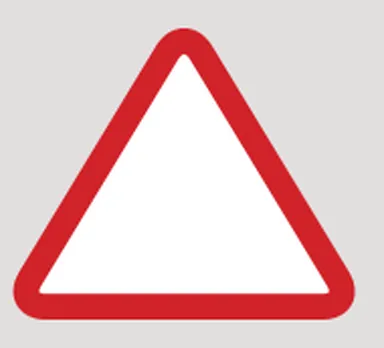
Q2.A sign with this shape and colour belongs to which group?
Warning signs
Prohibitive signs
Mandatory signs
Temporary signs
Show answer
Answer A: Warning signs. Warning signs are triangular in shape and offer a caution about a hazard ahead.
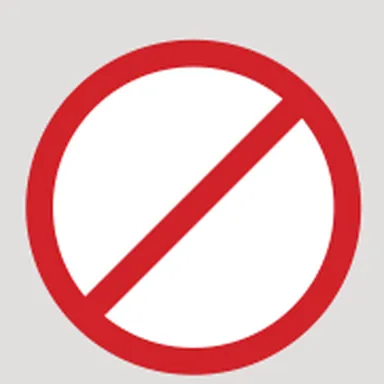
Q3.A round red sign like this belongs to which group?
Direction signs
Warning signs
Regulatory (mandatory) signs
Prohibitive signs
Show answer
Answer D: Prohibitive signs. Prohibitive signs are circular and red; they prohibit or restrict an action.
Q4.A round blue sign like this gives what kind of message?
A warning of a hazard ahead
A local direction
A prohibition or restriction
A positive instruction you must obey
Show answer
Answer D: A positive instruction you must obey. Regulatory (mandatory) signs are circular and blue and give positive instructions.
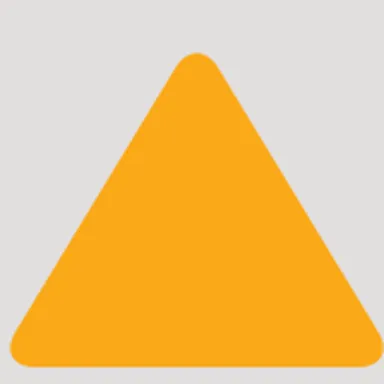
Q5.Signs on this orange background belong to which group?
Supplementary signs
Warning signs
Direction signs
Temporary signs
Show answer
Answer D: Temporary signs. Temporary signs, such as those used at road works, have an orange background.
Q6.Why are symbols used on traffic signs as much as possible?
They are visible from further away than words
They are cheaper to manufacture
They cannot be vandalised
They are more easily recognised and understood regardless of language
Show answer
Answer D: They are more easily recognised and understood regardless of language. Symbols are more easily recognised, understood and standardised irrespective of language.
Q7.What does a continuous line dividing two lanes mean?
Crossing or straddling it is prohibited
It marks the edge of the carriageway
You may cross it to overtake slow vehicles
It is only a recommendation
Show answer
Answer A: Crossing or straddling it is prohibited. Continuous lines are prohibitive: crossing or straddling a continuous line dividing two lanes is prohibited; broken lines are only guidance.
Q8.As a general rule about road markings, what does more paint indicate?
A temporary diversion
A more important message
A newer road surface
A higher speed limit
Show answer
Answer B: A more important message. The book’s rule of thumb: the more paint, the more important the message.
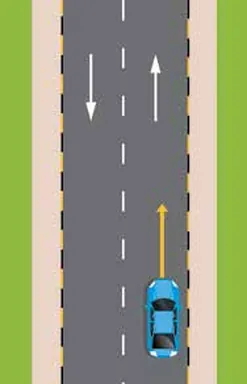
Q9.Is the blue car in the picture correctly positioned for a two-way road?
Yes, it is in the lane furthest to the right
No, it should be closer to the centre line
No, it should straddle both lanes
No, it should be in the left-hand lane
Show answer
Answer A: Yes, it is in the lane furthest to the right. On two-way roads a vehicle is driven in the lane furthest to the right, seen from the direction of travel.
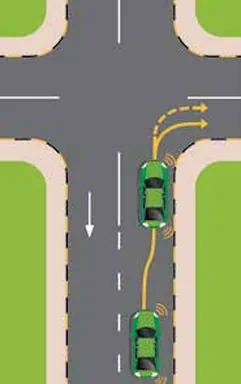
Q10.The green cars in the picture are turning right. Is their position correct?
No, they should stop in the middle of the road first
Yes, they keep as close to the right-hand edge as possible
No, they should use the left-hand lane
No, they should approach from the centre line
Show answer
Answer B: Yes, they keep as close to the right-hand edge as possible. Drivers turning right keep as close to the right-hand edge as traffic conditions allow, which stops others creeping up on the right.
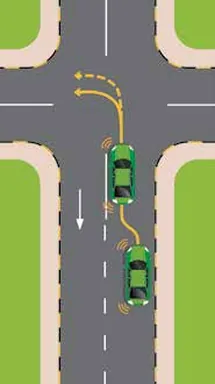
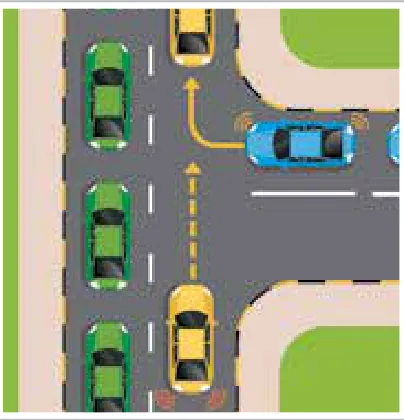
Q11.Is the blue car in the picture correctly positioned to turn left?
No, it should be on the hard shoulder
No, it should already be in the oncoming lane
Yes, close to the centre line
No, it should be at the right-hand edge
Show answer
Answer C: Yes, close to the centre line. Drivers turning left on two-way roads keep close to the centre line, and must give way to all oncoming traffic.
Q12.When is turning left at a junction permitted?
Only when you can turn safely without obstructing oncoming traffic or vehicles behind
Whenever the oncoming vehicle is more than 50 metres away
Whenever you have signalled in good time
Only when a green arrow is showing
Show answer
Answer A: Only when you can turn safely without obstructing oncoming traffic or vehicles behind. The law allows a left turn at a junction only if it can be made safely without obstruction to oncoming traffic and vehicles coming from behind.
Q13.On a narrow road there is a parked obstacle on your side of the road. Who must give way?
Whoever reaches the obstacle first has priority
The vehicle travelling faster has priority
You must give way to vehicles approaching from the opposite direction
The oncoming vehicle must give way to you
Show answer
Answer C: You must give way to vehicles approaching from the opposite direction. Vehicles on the same side of the road as an obstacle ahead must give way to vehicles approaching from the opposite direction.
Q14.A vehicle is following so closely that you fear it will run into you. What should you do?
Brake hard to warn the driver behind
Slow down slightly to increase your safety margin from the vehicle ahead
Switch on your hazard lights and continue
Speed up to increase the gap behind you
Show answer
Answer B: Slow down slightly to increase your safety margin from the vehicle ahead. If tailgated, slow down slightly so that your margin to the vehicle in front increases and you avoid sudden braking.
Q15.An oncoming car is heading towards you in your lane. What is the recommended action?
Speed up and pass it on the right
Stop in your lane and switch on hazard lights
Steer left into the other lane to pass it
Brake firmly, flash headlights repeatedly, use the horn; steer right only as a last resort
Show answer
Answer D: Brake firmly, flash headlights repeatedly, use the horn; steer right only as a last resort. Hold your brakes firmly, flash your headlights repeatedly and sound the horn; steering to the right is a last resort.
Q16.You intend to continue straight ahead through a junction. Which lane should you get into?
The right-hand lane, wherever possible, even if you must negotiate parked cars
Whichever lane is moving fastest
The middle of the road
The left-hand lane, to avoid parked cars
Show answer
Answer A: The right-hand lane, wherever possible, even if you must negotiate parked cars. Wherever possible, get into the right-hand lane to continue straight ahead, keeping right at or just before the junction even if parked cars are in the way.
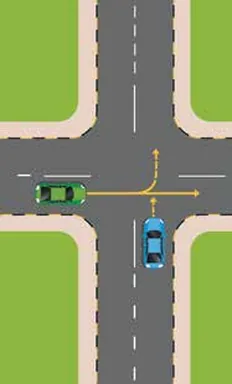
Q17.At this uncontrolled crossroads, which vehicle must give way?
The blue car, because the green car is approaching from its left
Neither, both may proceed together
The green car, because it is on the wider road
The green car, because the blue car is going straight ahead
Show answer
Answer A: The blue car, because the green car is approaching from its left. At junctions not controlled by lights or markings, priority is given to vehicles approaching from the left (the Left Hand Rule).
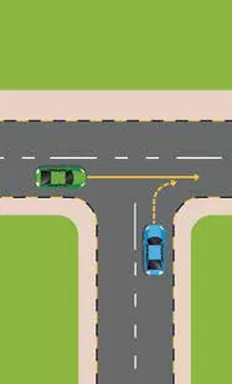
Q18.The blue car is entering the main road from a side road. What must it do?
Proceed, because it is on the right of the green car
Give way only to traffic from the right
Give way or stop for traffic from both left and right
Give way only to traffic from the left
Show answer
Answer C: Give way or stop for traffic from both left and right. Entering a primary, priority or main road you must give way or stop to traffic approaching from both directions (Main Road Rule).
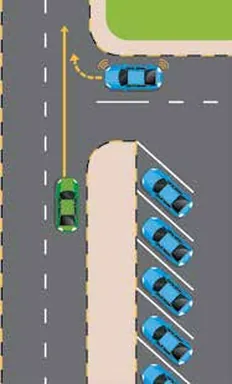
Q19.The green car is leaving a parking lot. Which rule applies?
The Left Hand Rule: it has priority over cars from the right
The Zipper principle: it alternates with the passing car
The Exit or Entering Rule: it must give way to all other traffic
The Bus Rule: it may pull out first
Show answer
Answer C: The Exit or Entering Rule: it must give way to all other traffic. Whenever you exit a parking lot, petrol station, residential area or similar, you must give way to all other traffic.
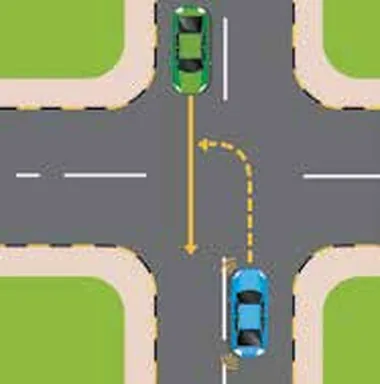
Q20.The blue car is turning left at the crossroads. To whom must it give way?
Only the oncoming vehicles
Oncoming vehicles and any pedestrians crossing its path
Nobody, a car turning left has priority
Only vehicles approaching from its left
Show answer
Answer B: Oncoming vehicles and any pedestrians crossing its path. The Turning Rule: when turning left at a crossroads you give way to oncoming motor vehicles and to pedestrians who may cross your path.
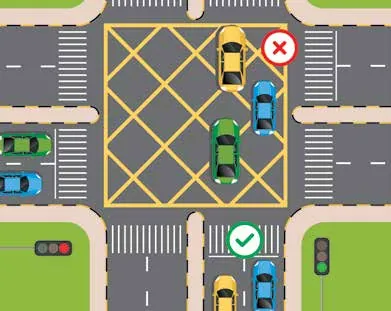
Q21.What is the yellow car marked with a red cross doing wrong?
Turning without indicating
Obstructing the crossroads during a traffic jam
Ignoring the Left Hand Rule
Overtaking on the right
Show answer
Answer B: Obstructing the crossroads during a traffic jam. Obstructing a crossroads or walkway during a traffic jam is prohibited; this is the Obstruction Rule.
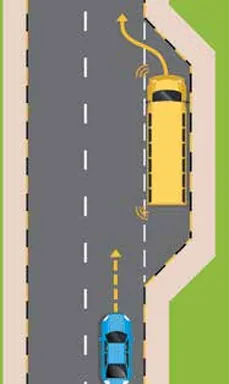
Q22.Inside city limits, the bus in the picture is leaving its stop. Who has priority?
Whichever vehicle moves first
Neither; both must stop
The bus; the blue car must let it leave the stop
The blue car, because it is already moving
Show answer
Answer C: The bus; the blue car must let it leave the stop. Buses leaving a bus stop have priority inside city limits (the Bus Rule).
Q23.What does the zipper principle mean where two roads meet in heavy traffic?
The car on the right always goes first
Cars merge in order of size
The car on the main road always goes first
One car from each road moves ahead alternately
Show answer
Answer D: One car from each road moves ahead alternately. Under the zipper principle vehicles from each road move ahead alternately; it is common at road works and in traffic jams.
Q24.When does the Left Hand Rule NOT apply?
Where a Give Way or Stop sign is present
At junctions without traffic lights
In parking lots and public areas
At junctions without road markings
Show answer
Answer A: Where a Give Way or Stop sign is present. The Left Hand Rule applies at uncontrolled junctions, including parking lots, but not where a Give Way or Stop sign is present.
Q25.Is the zipper principle acceptable where a sign shows the approaching traffic has priority?
No, a priority sign always overrides it
Only if a police officer is present
Yes, in congestion it is acceptable even though a sign gives the other traffic priority
Only outside city limits
Show answer
Answer C: Yes, in congestion it is acceptable even though a sign gives the other traffic priority. The book says the zipper principle is acceptable in rush hour, road works or jams even where a sign indicates the approaching traffic has priority.
Q26.An ambulance with flashing lights is approaching from behind. What should you do?
Speed up to clear the way ahead of it
Keep your lane and speed so it can pass
Stop immediately where you are
Slow down, pull over to the side and stop completely if necessary
Show answer
Answer D: Slow down, pull over to the side and stop completely if necessary. Always make way for emergency vehicles: slow down, pull over to the side of the road and stop completely if necessary.
Q27.Besides emergency vehicles, which of these must you also give priority to?
Taxis carrying passengers
School buses at all times
Military vehicles moving in convoy
Heavy goods vehicles on a hill
Show answer
Answer C: Military vehicles moving in convoy. You must also give priority to military vehicles in convoy, official convoys and rescue vehicle convoys.
Q28.Why are emergency vehicles on duty allowed to pass a red light or an island on the wrong side?
They must reach the scene as quickly as possible, provided they can do so safely
Their drivers have a special licence category
They are exempt from all laws at all times
Only when a police officer is directing them
Show answer
Answer A: They must reach the scene as quickly as possible, provided they can do so safely. Emergency vehicles on duty may breach the rules to reach an accident quickly, always provided they can do so safely.
Q29.Which pedestrian crossing is classed as “controlled”?
One where pedestrians are waiting to cross
One with a flashing amber signal
One controlled by a police officer or a traffic light
One with zebra markings only
Show answer
Answer C: One controlled by a police officer or a traffic light. Controlled crossings are those controlled by a police officer or traffic light; all others, even with a flashing amber signal, are uncontrolled.
Q30.How should you treat cyclists at an intersection?
Follow closely behind them
Sound the horn to warn them
Overtake them quickly to clear the junction
Avoid overtaking them and keep plenty of space, as they often wobble
Show answer
Answer D: Avoid overtaking them and keep plenty of space, as they often wobble. Avoid overtaking cyclists at intersections and give them plenty of room because they often wobble.
Q31.What point does the book make about courtesy in traffic compared with everyday life?
Traffic is a competition, so ordinary manners do not apply
The same rules of behaviour we use in other social interactions should apply on the road
Courtesy is only owed to pedestrians
Courtesy slows the traffic down
Show answer
Answer B: The same rules of behaviour we use in other social interactions should apply on the road. We open doors and queue politely as pedestrians; the same rules of behaviour should apply when we interact with other road users.
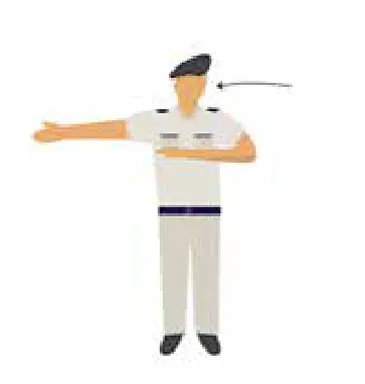
Q32.A police officer gives this beckoning signal from the side. What does it mean?
Vehicles from behind and ahead must stop
All vehicles must stop
Vehicles approaching from the left may continue
Slow down and pull over behind the police car
Show answer
Answer C: Vehicles approaching from the left may continue. Beckoning a vehicle from the side means vehicles approaching from the left may continue.
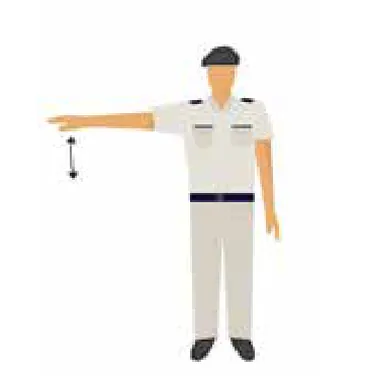
Q33.What does this police signal, arm out with the hand moving up and down, mean?
Slow down
You may proceed
Turn right
Stop
Show answer
Answer A: Slow down. This is the slow down signal; if given from a police car, follow it and pull over behind it when it stops.
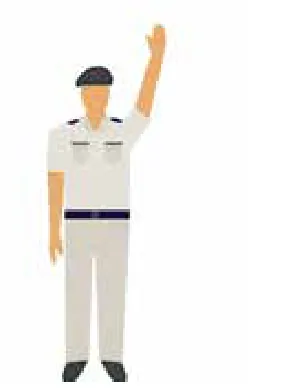
Q34.A police officer raises one hand straight up. What must you do?
Continue if you are approaching from the left
Stop; all vehicles must stop
Slow down and prepare to pull over
Proceed straight ahead only
Show answer
Answer B: Stop; all vehicles must stop. When the police officer raises a hand, all vehicles must stop.
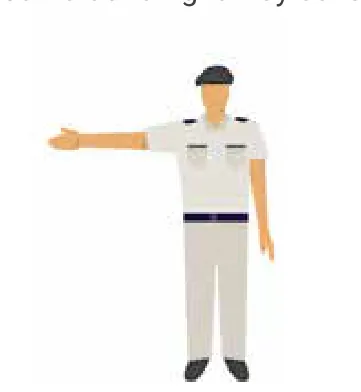
Q35.The officer stands with an arm extended forward. Which vehicles must stop?
Vehicles approaching from behind and ahead of the officer
Only vehicles approaching from the left
All vehicles from every direction
Vehicles approaching from left and right
Show answer
Answer A: Vehicles approaching from behind and ahead of the officer. With this signal, vehicles from behind and ahead must stop while those from left and right may continue.
Q36.The traffic light is green but a police officer signals you to stop. What do you do?
Go; the green light takes precedence
Wait for the light to turn red, then stop
Stop; the police officer’s signal takes precedence
Sound the horn and proceed slowly
Show answer
Answer C: Stop; the police officer’s signal takes precedence. Signals given by a police officer take precedence over traffic lights, signs and rules of the road.
Q37.A traffic light is flashing amber but a Stop sign is posted at the junction. What applies?
The flashing amber means you may proceed with caution
The Left Hand Rule applies
You must wait until the light turns green
The Stop sign takes precedence
Show answer
Answer D: The Stop sign takes precedence. When the light is flashing amber or switched off, traffic signs take precedence over the light.
Q38.What is the correct order of precedence when several instructions are given at once?
Rules of the road, traffic sign, traffic light, police officer
Traffic sign, traffic light, police officer, rules of the road
Police officer, traffic light, traffic sign, rules of the road
Traffic light, police officer, traffic sign, rules of the road
Show answer
Answer C: Police officer, traffic light, traffic sign, rules of the road. Police signals come first, then traffic lights, then traffic signs, and finally the general rules of the road.
Q39.A police car behind you flashes its blue and red lights alternately. What does it mean?
Move to the left lane to let it pass
Pull over to the side of the road and stop immediately
Follow the police car
Slow down but keep driving
Show answer
Answer B: Pull over to the side of the road and stop immediately. Alternately flashing blue and red lights from a police car behind you is an order to pull over and stop immediately.
Q40.At an uncontrolled crossing a pedestrian is about to step onto the road. What must you do?
Continue if you were there first
Give way to the pedestrian
Give way only if the pedestrian is a child
Sound the horn and continue
Show answer
Answer B: Give way to the pedestrian. You must give way at uncontrolled pedestrian crossings where pedestrians have stepped out or are just about to step onto the crossing.
Q41.How should you show that you are giving way to another vehicle?
Wave the other driver through
Slow down or stop in plenty of time
Flash your headlights once
Switch on your hazard lights
Show answer
Answer B: Slow down or stop in plenty of time. An obligation to give way requires a clear indication by slowing down or stopping in plenty of time.
Q42.Does giving an indicator signal release you from responsibility if an accident follows?
Yes, provided you signalled at least 3 seconds earlier
Only if you also sounded the horn
Yes, once you signal other drivers must yield
No, you must still keep watching and show consideration for others
Show answer
Answer D: No, you must still keep watching and show consideration for others. Giving a signal never releases you from responsibility in the event of an accident.
Q43.When may you use the horn?
To greet other drivers
Whenever you overtake
To hurry the car in front at a green light
Only to avert a danger, and no longer than necessary
Show answer
Answer D: Only to avert a danger, and no longer than necessary. Sound signals may only be used to avert danger and never longer than necessary.
Q44.In residential areas, between which hours must you not use the horn (except to avoid danger)?
Midnight to 6:00 am
Midnight to 8:00 am
10:00 pm to 6:00 am
11:00 pm to 5:00 am
Show answer
Answer A: Midnight to 6:00 am. The horn must not be used in residential areas from midnight to 6:00 am; flash your headlights instead to warn others at night.
Q45.When are you allowed to use hazard warning lights while driving?
In heavy rain to make yourself visible at high speed
Whenever you drive slowly
When parking illegally for a short time
Very briefly in a sudden traffic jam to warn the driver behind to brake hard
Show answer
Answer D: Very briefly in a sudden traffic jam to warn the driver behind to brake hard. Hazard lights are for emergencies or accidents; in a sudden jam they may be used briefly to warn the driver behind. Using them in heavy rain as an excuse for speed is forbidden.
Q46.What does flashing your headlights or high beam mean in traffic?
You are giving way to the other driver
Your hazard lights are on
The same as sounding the horn, no more and no less
You intend to overtake on the right
Show answer
Answer C: The same as sounding the horn, no more and no less. Flashing headlights has exactly the same meaning as sounding the horn — a warning, nothing more.
Q47.How can you warn a driver who is following too closely, using your stoplights?
Switch on the rear fog light
Press the horn twice
Switch the headlights off and on
Touch the brake pedal to flash your stoplight
Show answer
Answer D: Touch the brake pedal to flash your stoplight. Stoplights come on when you touch the brake; flashing them by touching the pedal warns a close follower or traffic behind you of a sudden jam.
Stop if you can do so safely; the light is about to change to red
Speed up to clear the junction before red
Traffic signs take precedence
Show answer
Answer B: Stop if you can do so safely; the light is about to change to red. Steady amber means stop if you can do so safely and brake smoothly, because red is about to follow.
Q49.A lane control sign above a lane shows a red cross. What does it mean?
The lane is for emergency vehicles only
The lane is closing 500 m ahead
The lane is closed to traffic
Overtaking in the lane is prohibited
Show answer
Answer C: The lane is closed to traffic. Lane control signs are mounted above lanes; a red cross means that lane is closed to traffic.
Q50.You turn onto another road and see the pedestrian light there is green. What must you do?
Stop and wait for the pedestrian light to turn red
Give way to the pedestrians
Continue, because your own light was green
Sound the horn to warn the pedestrians
Show answer
Answer B: Give way to the pedestrians. When turning, remember the pedestrian light may be green; if so, you must give way.
Q51.What does a continuously flashing amber traffic light mean?
It is a warning only; traffic signs, or else the normal rules, apply
Stop and wait for green
Proceed; you have priority
The lights are about to turn red
Show answer
Answer A: It is a warning only; traffic signs, or else the normal rules, apply. Continuous flashing amber does not regulate traffic; it is a warning, and traffic signs (or the general rules) take precedence.
Keeping a safe following distance and checking the rear-view mirror frequently
Driving slightly below the speed limit at all times
Staying in the left lane to avoid merging traffic
Show answer
Answer B: Keeping a safe following distance and checking the rear-view mirror frequently. Defensive driving means thinking ahead, active observation, a safe following distance, frequent mirror checks and braking in good time.
smartphone Android app
Practise anywhere, even offline
The free Android app has the same questions, a timed mock exam, road-sign flashcards and a daily practice streak. Sign in with Google to keep it in step with this website.