Chapter 8: Safety While Driving — theory test questions and answers
44 practice questions for the UAE driving theory test on car safety, the natural laws, more about handling different cars and more, each with the correct answer and a short explanation from the handbook. Try each one before you open the answer.
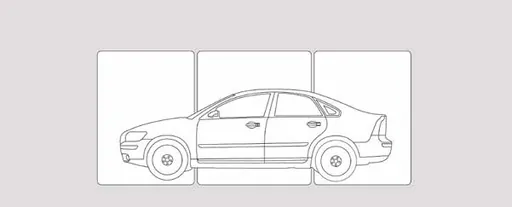
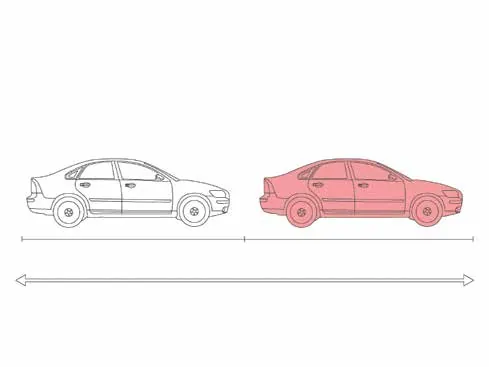
Q1.What do the front and rear zones marked in this diagram do in a crash?
Store the fuel safely
House the airbags
Absorb much of the impact force, reducing the effect on the occupants
Stiffen the car so it does not bend
Show answer
Answer C: Absorb much of the impact force, reducing the effect on the occupants. Deformation zones at the front and back absorb much of the force of an impact; older and big 4WD vehicles pass more force to the occupants.
Q2.In which vehicles do occupants take a higher percentage of the collision force?
Older vehicles and big 4WD cars
Modern small cars
Cars with side impact protection
Cars with airbags
Show answer
Answer A: Older vehicles and big 4WD cars. In older or 4WD vehicles the occupants take a higher share of the collision force than in a modern car with deformation zones.
Q3.Why are side-impact collisions particularly dangerous?
The airbags do not work
The fuel tank is at the side
Injuries to the upper body and head can be particularly serious; side protection is harder
The doors always jam shut
Show answer
Answer C: Injuries to the upper body and head can be particularly serious; side protection is harder. Protecting occupants in a side impact is more difficult; even with side impact protection, upper-body and head injuries can be very serious.
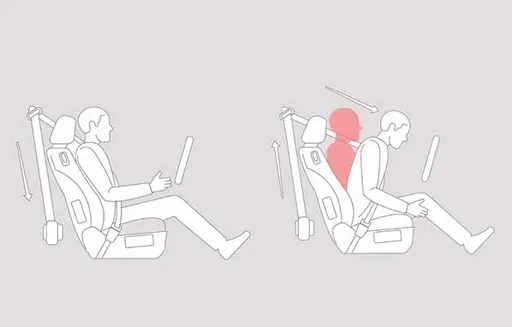
Q4.In this picture, how should the head restraint be set to protect against whiplash?
Reaching to the top of the head, sitting close to the backrest and restraint
Removed, to improve rear vision
At neck level, sitting well forward
At shoulder level
Show answer
Answer A: Reaching to the top of the head, sitting close to the backrest and restraint. For maximum protection the head restraint should reach the top of the head (about mid-back of the head for tall people); sit close to the backrest.
Q5.What is a whiplash injury?
A burn from the seat belt
A knee injury from the dashboard
A chest injury from the airbag
A head or neck injury from running into the car in front or being hit from behind
Show answer
Answer D: A head or neck injury from running into the car in front or being hit from behind. Whiplash is a head/neck injury from a rear-end collision (either direction); the head restraint is designed to reduce it.
Q6.How should heavy objects be carried in a car?
Anywhere, provided the car is not overloaded
On the front passenger seat
Never loose; place cargo as low as possible and secure it with the seat belts in the back
On the rear parcel shelf
Show answer
Answer C: Never loose; place cargo as low as possible and secure it with the seat belts in the back. Never keep heavy objects loose; place cargo as low as possible and use the seat belts to secure it in the back seat.
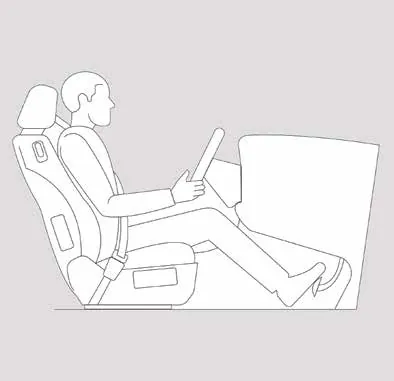
Q7.How should the diagonal belt shown here fit?
Under the arm, across the stomach
Loose, so it is comfortable on long trips
Twisted once so it grips better
Tight, across the chest and shoulder, close to the neck without constricting it
Show answer
Answer D: Tight, across the chest and shoulder, close to the neck without constricting it. A tight, untwisted belt gives more protection; the diagonal belt runs over the shoulder close to the neck, and the lap belt sits snugly on the hips, not the stomach.
Q8.Why must rear-seat passengers wear seat belts?
Only to avoid a fine
It is optional in the back seat
Only when the car has no airbags
In a crash they are hurled forward and can injure the front occupants too
Show answer
Answer D: In a crash they are hurled forward and can injure the front occupants too. Seat belts are as important in the back as in the front; an unbelted rear passenger thrown forward can kill a front-seat occupant.
Q9.Who is responsible for ensuring all passengers wear their seat belts?
The front-seat passenger
The driver
Each passenger individually
The vehicle owner
Show answer
Answer B: The driver. The driver has the responsibility of ensuring that all passengers wear seat belts.
Q10.Falling full length from a standing position equals an impact at what speed, the maximum the arms can withstand?
50 km/h
7 km/h
15 km/h
25 km/h
Show answer
Answer B: 7 km/h. Falling from standing equals 7 km/h — the most the arms can withstand; falling from a chair equals 15 km/h; a three-storey fall equals 50 km/h.
Q11.What does a seat belt pretensioner do?
Locks the door in a crash
Warns if the belt is not fastened
Automatically tightens the seat belt in the event of a crash
Loosens the belt when parked
Show answer
Answer C: Automatically tightens the seat belt in the event of a crash. Some new cars have a pretensioner or tensioner that automatically tightens the belt in a crash.
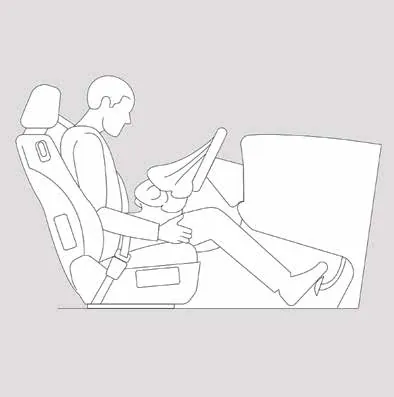
Q12.What does SRS stand for, and what does the picture show it works together with?
Side Restraint Shield; it works with the head restraint
Safety Release System; it replaces the seat belt
Seat Restraint Support; it works with the child seat
Supplementary Restraint System; it works together with the seat belt
Show answer
Answer D: Supplementary Restraint System; it works together with the seat belt. The airbag (SRS, Supplementary Restraint System) is a supplement to the seat belt; together they give extra protection.
Q13.What is the minimum height for a passenger to travel safely in a seat with an airbag?
At least 160 cm
There is no minimum if a seat belt is worn
At least 145 cm, and wearing a seat belt
At least 120 cm
Show answer
Answer C: At least 145 cm, and wearing a seat belt. A passenger must be at least 145 cm tall and belted to travel safely where there is an airbag; a child in the front can be killed by an airbag.
Q14.Why is placing a child on the driver’s lap “asking for trouble”?
It is only unsafe above 60 km/h
In a crash the child is crushed between driver and wheel with many times its weight
Nothing, if the adult wears a belt
The child should face the other way
Show answer
Answer B: In a crash the child is crushed between driver and wheel with many times its weight. A child on the driver’s lap is “love based on ignorance”: in an accident the child is trapped between wheel and body with a force several times its weight.
Q15.Up to roughly what age is it much safer for a child to travel facing rearwards?
Approximately 9 months
Approximately 1 year
Approximately 10 years
Approximately 4 years
Show answer
Answer D: Approximately 4 years. Rearward-facing is the best way up to about 4 years; it absorbs violent shocks and protects the child’s sensitive head and neck.
Q16.What does the book say about an improperly mounted child seat?
It is far more dangerous than not using a child seat at all
It is still better than no seat
It is fine on short trips
It only matters for infants
Show answer
Answer A: It is far more dangerous than not using a child seat at all. Improper mounting is far more dangerous than no child seat; follow the manufacturer’s instructions and anchor the seat securely.
Q17.Under UAE law, where must all children under the age of ten sit?
Anywhere, if secured in a child seat
In the front seat with the airbag switched off
In the rear seat only on motorways
In the rear seat, wearing a seat belt or secured in a protective seat
Show answer
Answer D: In the rear seat, wearing a seat belt or secured in a protective seat. UAE law requires all children under ten to be in the rear seat, belted or in a protective seat; they should never ride in the front.
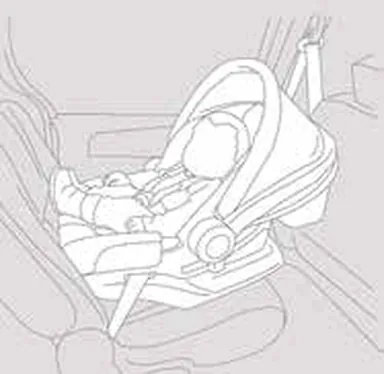
Q18.May a rear-facing seat like this be placed in front of a passenger airbag?
Yes, if the seat is firmly anchored
Never — there is an extremely high risk of severe injury or death
Only for journeys under 30 minutes
Yes, if the airbag is switched off
Show answer
Answer B: Never — there is an extremely high risk of severe injury or death. Under no circumstances place an infant seat, rear-facing seat, booster or cushion in front of a passenger airbag; the safest place is the back.
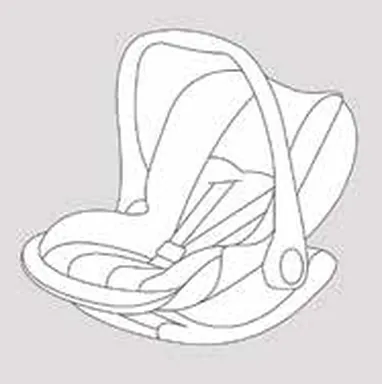
Q19.For which age group is this small, lightweight infant seat recommended?
From 4 years to 10–12 years
Up to around 9 months
From 1 year until 18 kg
From 9 months to 4 years
Show answer
Answer B: Up to around 9 months. The infant seat is for babies up to around 9 months and is the safest way for the youngest passengers to travel.
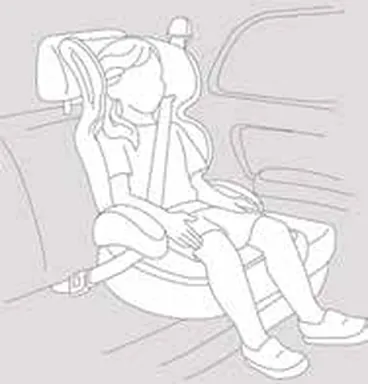
Q20.The child in the picture uses a booster seat with the seat belt. For what age range is this recommended?
From around 4 years up to age 10–12
From birth to 1 year
From 9 months to 4 years
Up to around 9 months
Show answer
Answer A: From around 4 years up to age 10–12. A booster seat or cushion with the seat belt is for children from around 4 years up to 10–12.
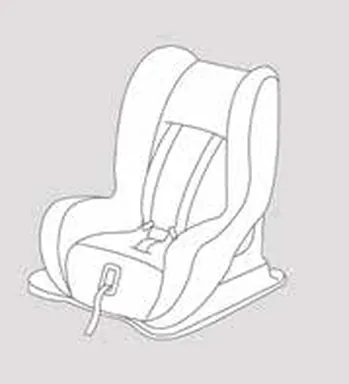
Q21.This forward-facing child seat has a full harness. From what age or weight may it be used?
From 4 years
From 10 years
From birth
From age 1 or 10 kg, until the seat is outgrown at around 18 kg
Show answer
Answer D: From age 1 or 10 kg, until the seat is outgrown at around 18 kg. An American-style forward-facing seat with full harness may replace the rear-facing seat from age 1 or 10 kg until outgrown, usually around 18 kg — but rear-facing is safer for longer.
Q22.To protect a rear-facing child’s head, where should the top of the head be relative to the seat shell?
Level with the top of the shell
Above the top of the shell
At least 1 inch below the top of the shell
It does not matter
Show answer
Answer C: At least 1 inch below the top of the shell. The top of a rear-facing child’s head should be at least 1 inch below the top of the safety seat’s shell.
Q23.Why is leaving a child inside a parked vehicle so dangerous?
The child may lock the doors
Children may release the handbrake
A small body heats up 3 to 5 times faster than an adult’s and can suffocate
The battery may go flat
Show answer
Answer C: A small body heats up 3 to 5 times faster than an adult’s and can suffocate. Forgetting a child in a car can cause suffocation and death because a small body heats 3–5 times faster than an adult’s.
Q24.Under Article 350 of the UAE penal code, what is the penalty for exposing a child under seven to danger?
Loss of the driving licence
A fine of one thousand dirham
A warning only
Detention or a fine not exceeding ten thousand dirham
Show answer
Answer D: Detention or a fine not exceeding ten thousand dirham. Article 350: detention or a fine not exceeding ten thousand dirham for exposing a child under seven to danger in a crowded place.
Q25.What happens to the risk of fatal injury if a car’s safety systems are used as designed?
It stays about the same
It decreases dramatically
It only changes in head-on crashes
It increases slightly at low speed
Show answer
Answer B: It decreases dramatically. If the safety system is used as designed, the risk of fatal injury in an accident decreases dramatically.
Q26.Why is an airbag dangerous for a child riding in the front seat?
It only protects tall adults from side impacts
It deploys faster than the blink of an eye and can seriously injure or kill a child
It is too soft to hold a child
It cannot deploy if a child seat is fitted
Show answer
Answer B: It deploys faster than the blink of an eye and can seriously injure or kill a child. An airbag is not a soft pillow; it deploys extremely fast and can seriously injure or kill a child in the front seat.
Q27.Even if the passenger airbag is switched off, where is the safest place for children of 10 and under?
In the front seat with a booster
In the rear seat
On an adult’s lap
In the front seat facing rearwards
Show answer
Answer B: In the rear seat. Even with the airbag off or absent, the safest place for all children 10 and below is the rear seat.
Q28.According to this diagram, what makes up the stopping distance?
Braking distance only
Thinking distance minus braking distance
Reaction time multiplied by speed
Thinking distance plus braking distance
Show answer
Answer D: Thinking distance plus braking distance. Stopping distance = thinking distance (while you react) + braking distance (after you apply the brakes).
Q29.At 80 km/h, roughly how far do you travel during a normal one-second reaction time?
Approx. 24 m
Approx. 12 m
Approx. 48 m
Approx. 36 m
Show answer
Answer A: Approx. 24 m. Thinking distance ≈ 3 × (speed ÷ 10): 12 m at 40 km/h, 18 m at 60, 24 m at 80, 30 m at 100, 36 m at 120.
Q30.What is a normal reaction time, and how do beginners compare?
Two seconds; the same for everyone
One second; beginners often take longer due to lack of experience
Three seconds; beginners are quicker
Half a second; beginners are faster
Show answer
Answer B: One second; beginners often take longer due to lack of experience. Normal reaction time is one second; beginners often take longer, so experienced drivers with shorter thinking distances stop sooner.
Q31.If you double your speed from 40 to 80 km/h, what happens to the braking distance?
It doubles
It becomes four times as long
It stays the same but thinking distance doubles
It becomes three times as long
Show answer
Answer B: It becomes four times as long. Braking distance increases with the square of speed: twice the speed = 4× the braking distance; three times = 9×; four times = 16×.
Q32.Tripling your speed from 40 to 120 km/h makes the braking distance how many times as long?
Nine times
Twelve times
Six times
Three times
Show answer
Answer A: Nine times. Braking distance increases as the square of the speed increase: 3 × 3 = 9 times.
Q33.In an emergency in a car without ABS, how should you brake?
Brake hard immediately without locking the wheels; if they lock, reduce pressure quickly
Brake lightly at first, then harder
Pump the brakes gently
Pull the handbrake
Show answer
Answer A: Brake hard immediately without locking the wheels; if they lock, reduce pressure quickly. Brake hard immediately but avoid locking the wheels; without ABS, if the wheels lock, reduce brake pressure as quickly as possible.
Q34.Which of these does braking distance depend on?
The gradient of the road
The number of passengers wearing seat belts
The colour of the car
The time of day
Show answer
Answer A: The gradient of the road. Braking distance depends on speed, road state, gradient, brake and tyre condition, and braking technique.
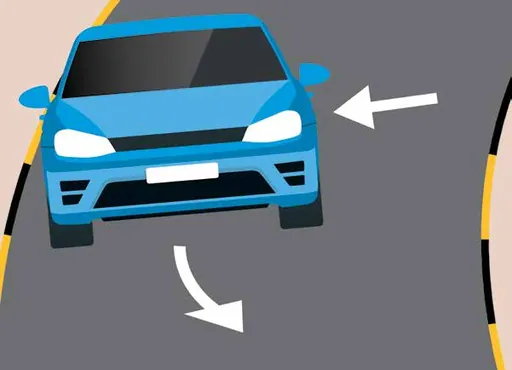
Q35.The arrows in this picture show which force acting on the car in the bend?
Gravity pulling the car downhill
Engine braking slowing the car
Centrifugal force pushing the car straight on; too much speed and the tyres lose grip
Wind pushing the car sideways
Show answer
Answer C: Centrifugal force pushing the car straight on; too much speed and the tyres lose grip. A car tends to travel straight on in a bend; the centrifugal force must not exceed the tyres’ grip, so slow down before the bend and accelerate gently out.
Q36.On a steep downhill, what does the book recommend to avoid overheating the brakes?
Switch off the engine to save fuel
Coast in neutral
Change down a gear (automatic or manual) and let the engine do the work
Use the handbrake lightly
Show answer
Answer C: Change down a gear (automatic or manual) and let the engine do the work. Gravity works on cars as on bicycles: change down a gear and let the engine do the work rather than risk overheating the brakes or losing control.
Q37.How can you shorten your thinking distance when you anticipate danger?
Keep your foot poised above the brake pedal and be ready to react
Rev the engine
Change to a lower gear
Look in the mirror
Show answer
Answer A: Keep your foot poised above the brake pedal and be ready to react. Being prepared shortens thinking distance: keep your foot poised over the brake and be ready; slowing early by easing off the accelerator is safer still.
Q38.What is the correct way to take a bend?
Keep a constant high speed throughout
Accelerate into it and brake at the apex
Slow down as you approach and accelerate gently out of it
Brake hard in the middle of the bend
Show answer
Answer C: Slow down as you approach and accelerate gently out of it. Slow down as you approach a bend and accelerate gently out of it; read the road ahead for sharp bends and slippery patches.
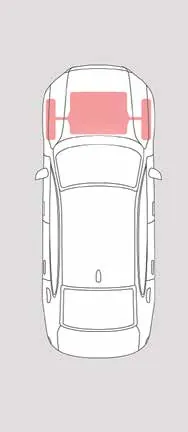
Q39.Which drive layout is highlighted in this diagram?
Front wheel drive
Mid-engine rear drive
Four wheel drive
Rear wheel drive
Show answer
Answer A: Front wheel drive. Cars may be front-, rear- or four-wheel drive; the drive layout changes how a car behaves, so think about it before driving an unfamiliar car.
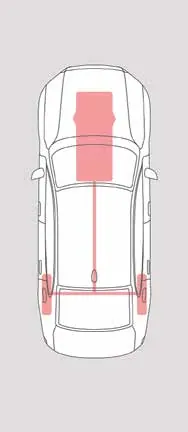
Q40.Which drive layout is highlighted in this diagram?
Front wheel drive
Four wheel drive
Front wheel drive with rear engine
Rear wheel drive
Show answer
Answer D: Rear wheel drive. Power goes via a shaft to the rear wheels; rear-wheel-drive cars are more prone to the rear losing grip under heavy acceleration in bends.
Q41.Before driving a car you have never driven, which of these should you consider?
The colour of the seats
Whether the radio works
How many cup holders it has
How the car’s stability is influenced by the load it carries
Show answer
Answer D: How the car’s stability is influenced by the load it carries. Consider tyre condition, brake performance in an emergency, transmission differences, shock absorbers and how load affects stability.
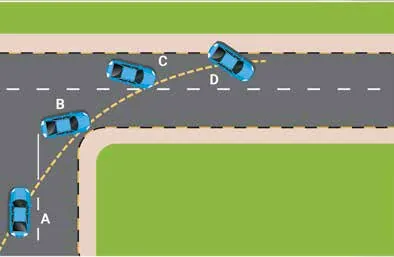
Q42.The car in the picture responds to steering more than expected and its rear swings out. What is this called?
Fishtailing due to a puncture
Oversteer
Aquaplaning
Understeer
Show answer
Answer B: Oversteer. Oversteer: the car responds more than expected and may spin if grip is lost; a heavy weight in the rear can cause it.
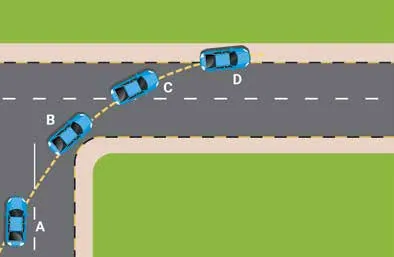
Q43.The car in the picture runs wide on the bend despite the correct steering angle. What is this called?
Understeer
Rear-wheel lock
Centrifugal spin
Oversteer
Show answer
Answer A: Understeer. Understeer is loss of front-wheel traction while cornering, forcing you wide; front-engined cars normally understeer.
Q44.What can cause a normally understeering car to oversteer?
Driving with the windows open
Using engine braking
Carrying a heavy load in the rear
Fitting new front tyres
Show answer
Answer C: Carrying a heavy load in the rear. A heavy weight in the rear can cause oversteer, even in a car that normally understeers.
smartphone Android app
Practise anywhere, even offline
The free Android app has the same questions, a timed mock exam, road-sign flashcards and a daily practice streak. Sign in with Google to keep it in step with this website.